
The 60/40 is broken, says Morgan Stanley's Wilson — and gold is the fix
Morgan Stanley's CIO argues stocks and bonds no longer hedge each other, that gold has quietly been in a 25-year bull market — and that the answer is a 60/20/20 portfolio with a fifth in gold.

With the traditional 60/40 portfolio no longer delivering the performance and safety it once did, Morgan Stanley chief US equity strategist and CIO Mike Wilson argues gold and other commodities have earned a place in the mix — and that gold has in fact been in a 25-year bull market.
Speaking to Bloomberg TV on Friday, Wilson said 2022 exposed the core problem with traditional asset allocation: stocks and bonds fell together, an event he called a first in our lifetimes, stripping the 60/40 of the hedge it depends on.
Though that equity drawdown was smaller than 2008 or 2001-02, the 60/40's losses were comparable — which is what began pushing investors to worry about equities and defensive assets failing at the same time.
Wilson's advice to long-term investors is unchanged in one respect: do not chase tops or panic out of bottoms. He still favours dollar-cost averaging into diversified portfolios, and argues 2022 ultimately proved that investors who stayed invested were rewarded.
Asked how to defend a portfolio when bonds are weak and risk is rising, Wilson said correlations between traditional assets are climbing: equities and bonds no longer provide natural diversification, so investors need to look elsewhere.
Gold, he argues, provides inflation resistance and defence in exactly this environment — not because it yields anything, but because it behaves as a defensive asset.
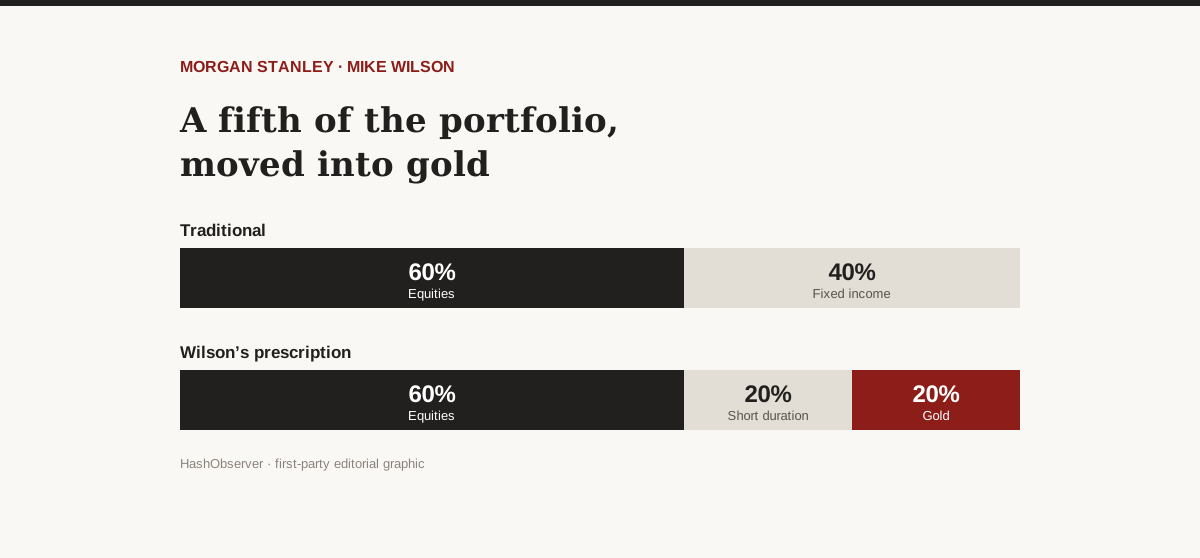
His concrete prescription is a 60/20/20 split: 60% equities, 20% shorter-duration fixed income, and 20% gold. "Gold is now the anti-fragile asset to own, rather than Treasuries," he said.
That does not mean abandoning fixed income altogether: Wilson favours cutting bond duration, restructuring the fixed-income sleeve to control rate risk while keeping some diversification.
Nor, in his telling, did gold's bull market start this year. Gold has been in a bull market for 25 years, he says — investors only began to recognise it clearly at the start of this year.
Wilson also sees 2026 as the year of a broad commodity rotation. After the Fed launched its reserve-management programme late last year, shifting liquidity first lifted gold and silver miners, then rare-earth and metals stocks, then energy — finally spreading to semiconductors.
What do they have in common, he asks: they are all commodities. In his reading, the rotation shows investors hunting for assets outside equities — but with commodity-like properties — to offset the equity risk concentrated in their portfolios.