
Three governors wanted a hike. Thursday's minutes show how close they came
The July statement recorded a 9–3 vote with three dissenters pressing for a quarter-point increase — while fund managers were betting almost unanimously on no hike before the midterms.

The Federal Open Market Committee left its target range for the federal funds rate at 3-1/2 to 3-3/4 percent on 29 July and said it would continue "its policy of maintaining ample reserves in the banking system." The minutes of that meeting are released on Thursday.
The vote was 9–3. Beth M. Hammack, Neel Kashkari and Lorie K. Logan each dissented, preferring "to raise the target range for the federal funds rate by 1/4 percentage point at this meeting." Three dissents in the same direction is the sharpest split the Committee has recorded this cycle.
The statement's own description of the economy explains why they pushed. Growth is holding up: "Productivity growth and capital investment are strong," and on the labour market, "Job gains have kept pace with the workforce, and the unemployment rate has changed little."
Inflation is the unresolved half. The Committee wrote that inflation "remains elevated relative to the Committee's 2 percent goal, in part reflecting supply shocks that have driven price increases in certain sectors, including energy" — a clause that has aged pointedly, with Brent near $90 and the US diesel crack at a record.
What makes Thursday's release worth reading is the gap between that vote and how markets are positioned. Bank of America's August Global Fund Manager Survey, conducted 7–13 August among 180 managers running $525 billion, found 72% expecting no Fed hike before the November midterms.
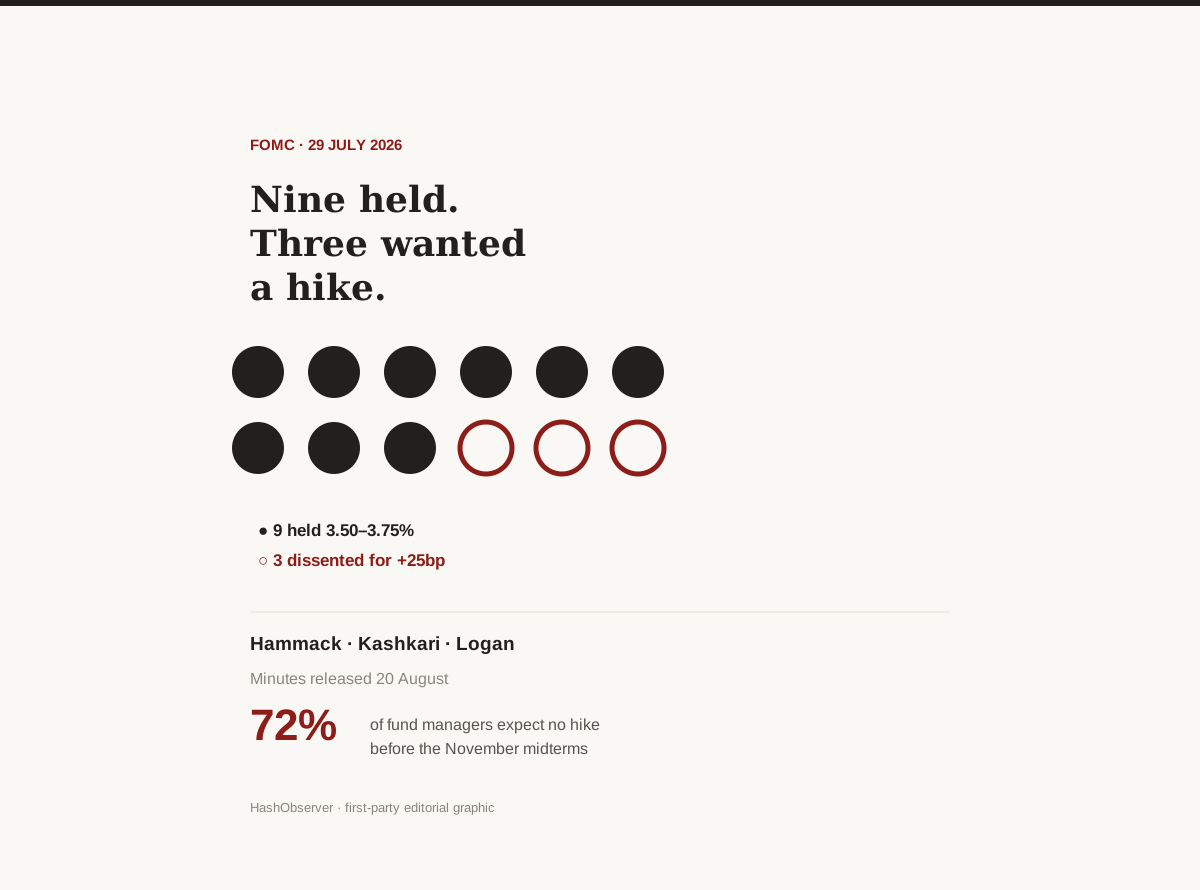
So the market has priced near-certainty on an outcome that three of twelve voters opposed three weeks ago. The minutes are the first documentary evidence of how isolated those three were — whether the nine were comfortable or merely waiting.
Three questions the text can settle. First, how many non-dissenting participants nonetheless favoured tightening soon: the minutes distinguish between "participants" and "a few" or "several," and that vocabulary is where the true balance shows.
Second, whether the energy-driven inflation the statement singled out was read as a passing supply shock or as something that has begun to leak into expectations. The statement's own wording, "in part reflecting supply shocks," leaves that deliberately open.
Third, what was said about reserves. The statement's commitment to "maintaining ample reserves" is short in the released text; any discussion of where ample stops being ample would matter well beyond the rate decision.
The release is scheduled for Thursday 20 August. Minutes are published three weeks after each decision, so this is the first full account of the July meeting available to anyone outside the Committee.