
Long yields at a 19-year high, and Wall Street sees no turn
The 30-year reached 5.31%, its highest since July 2007. Rising discount rates are now doing to AI valuations what no earnings miss has managed.

A broad sell-off in global bonds is lifting borrowing costs for governments, companies and households across developed economies at the same time. Long-dated Treasury yields have reached a 19-year high, and investors say they cannot yet see where the trend ends.
Several forces are pushing at once: the US–Iran conflict feeding inflation worries, technology companies crowding into bond issuance and competing for fund money, and uncertainty about the federal deficit and the Fed's direction.
Which matters most is hard to separate, but most investors expect none of them to fade quickly. The deeper reason is that the US economy has stayed resilient at rate levels once thought high enough to slow it visibly — and activity has not cooled.
Some read this as a return rather than a shock: if the 2008–09 crisis opened an era of ultra-low rates, the current environment may simply be a move back toward pre-crisis normal. "Basically, this is a normalisation," said Robert Tipp, chief investment strategist and head of global bonds at PGIM Fixed Income.
The numbers are specific. The 30-year Treasury yield reached about 5.31% on 17 August, its highest since July 2007, and briefly approached 5.33% the following morning. The 10-year sits near its highest since January 2025, and several European sovereign yields have hit multi-year highs.
Middle East risk amplifies the move. Fading prospects for a settlement lift oil, and higher energy prices harden expectations that inflation persists — which pushes long yields further. "It's almost like a domino effect," said Burns McKinney, portfolio manager at NFJ Investment Group. "Talks break down, oil goes up, oil brings higher inflation expectations, and that pushes yields higher."
The pressure has not passed fully into the economy, but it has started to spread. US equities were near record highs and corporate earnings strong, letting investors absorb higher funding costs for a while.
Sustained higher yields change the valuation arithmetic. When long rates rise, the discounted value of future profits falls, and high-growth, high-multiple technology stocks take the clearest hit.
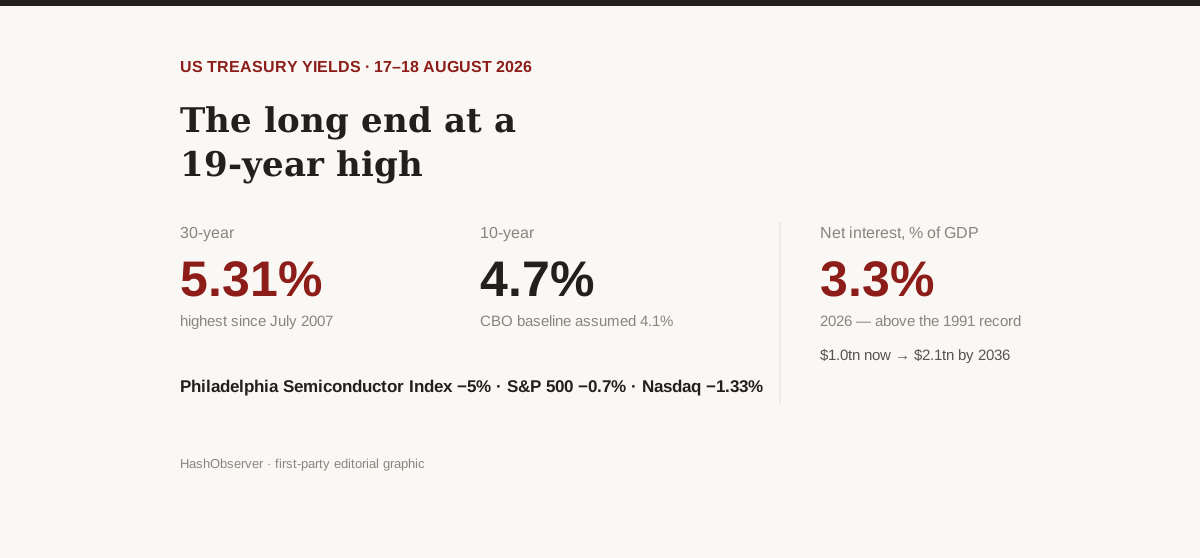
On Tuesday the major indices closed lower. The S&P 500 fell 0.7% and the Nasdaq 1.33%, the sharpest single-day drops since 29 July; the Dow slipped 0.22%. The Philadelphia Semiconductor Index fell more than 5%, and information technology was the weakest of the S&P 500's eleven sectors, down 1.9%.
Individual moves were larger. Nvidia fell 2.3% and Micron 7% after a near-18% run over the previous five sessions; SanDisk dropped 9% and Western Digital 7.4%, ending a five-session advance for memory names. The VIX closed at 15.84, its highest since 4 August.
"Nothing breaks momentum like rising rates, and we're seeing signs of that now," said Tony Welch, chief investment officer at SignatureFD, who reads higher yields as a sign that policy may still be loose for this growth and inflation mix.
If yields hold, the fiscal arithmetic tightens first. Close to a fifth of US federal revenue already goes to debt interest. Net interest costs reach 3.3% of GDP in 2026 on Congressional Budget Office projections — above the previous record set in 1991 — and rise from roughly $1.0 trillion this year to nearly $2.1 trillion by 2036.
CBO's own baseline assumed a 10-year yield near 4.1%; it is around 4.7% now. With publicly held debt near 100% of GDP, the office estimates that rates just 0.1 percentage point above forecast add $379 billion to future net interest.
"The problem isn't entirely rising rates," said Michael Strain, director of economic policy studies at the American Enterprise Institute. "The real problem is the deficit. If we could focus on only one thing, it should be the deficit outlook over the next decade."
The politics follow the curve. Treasury yields price the 30-year mortgage, which President Trump has repeatedly promised to bring down, and Treasury Secretary Scott Bessent said early in the term that the administration would try to hold the 10-year down, partly by shrinking deficits and so the supply of new debt markets must absorb.
Recent steps read as attempts at the same goal — including intervening in currency markets to support the yen, easing pressure on Japan to sell Treasuries to buy its own currency. Yields kept rising anyway. "The Treasury secretary's earlier actions may not have had the intended effect, which is another reason to think the rise can continue," said Zach Griffiths, head of investment grade and macro strategy at CreditSights.