
Mizuho expects the Bank of Japan to move to quarterly hikes — and says the momentum will be hard to stop
Swaps put 78% odds on a September move. Mizuho holds almost all of its ¥41 trillion government-bond book inside one year, which tells you what it expects next.

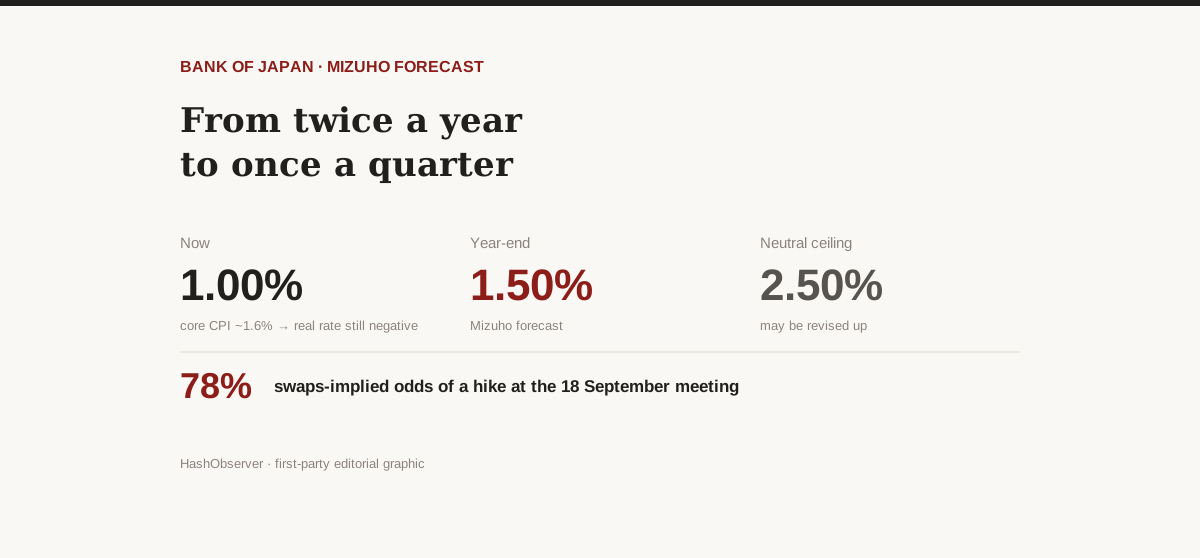
With the yen weak and price pressure persisting, Mizuho Financial Group has turned markedly hawkish on Japanese policy. Kenya Koshimizu, co-head of the group's global markets business, said in an interview that the Bank of Japan will most likely move as soon as next month, and may shorten the interval between hikes from six months to three.
His arithmetic is simple: with core consumer prices rising about 1.6%, a 1% policy rate is still negative in real terms. Once the Bank starts moving quarterly, he argues, that tightening momentum will be hard to reverse. Overnight index swaps price a 78% probability of a hike at the 18 September meeting.
Behind the shift is more than a soft currency. People familiar with the matter say the Takaichi government is comfortable with recent tightening. Koshimizu expects the policy rate to reach 1.5% by year-end, and argues that as a capital-spending boom lifts productivity, Japan's ceiling for the neutral rate may be revised up from the current 2.5%.
Rising rates usually pull money back into bonds, but Mizuho's own positioning is defensive. Koshimizu said almost all of the Japanese government bonds in its ¥41 trillion securities portfolio have less than a year to maturity — an ultra-short-duration stance held to avoid writedowns as rates rise.
He does not find the long end attractive yet. The 10-year JGB yield has touched a 30-year high near 2.9%, but against nominal growth of about 4% he still reads it as low, and not yet at a level worth building a position.
Mizuho is confident enough about inflation itself to be buying inflation-linked government bonds. Koshimizu sees Japan going through a structural transition unseen in decades, one lifting loan demand and improving the earnings base for companies.
Earnings support the case. Per Bloomberg's tally, about 71% of listed Japanese companies beat profit expectations in the season just ended. Aggregate net profit at the largest 500 exceeded ¥21 trillion, breaking last year's record, and margins for Topix constituents are expected to reach 9.3% — the highest in more than three decades.
The rally's composition is changing with it. Gains had been concentrated in AI and semiconductor names; the latest earnings show the advance spreading into domestic-demand sectors.
"Japanese companies suffered from rising costs for years, and are now lifting profitability by passing prices through successfully," said Yasuhiko Hirakawa, head of equity investment at Rakuten Investment Management, who sees that newly established pricing power as the core of the market's durability.
Mizuho reads it the same way. Koshimizu called Japanese equities "a highly attractive asset" given the structural global shifts working in Japan's favour, and said the bank is building exposure through index funds.
Second-quarter GDP showed consumption and capital spending slowing slightly, but analysts have been raising profit forecasts regardless: Topix earnings-per-share growth for this year is now estimated at 6.9%, against 4.9% for the S&P 500.
"From gaming and food to healthcare, more sectors are drawing flows," said Chisa Kobayashi, a strategist at UBS SuMi Trust Wealth Management — a cross-sector earnings recovery she reads as moving Japan from a re-rating story to an earnings-driven one.