
Japan's interest bill outran the finance ministry's own arithmetic in six months
Reuters, citing Kyodo, puts next year's debt-service request at a record ¥36.64 trillion — nearly ¥2 trillion above the figure the ministry itself published for that same year back in February. Monday's official yield table shows how far the rate environment has moved.

The Ministry of Finance updates one unglamorous page every business day: a table of what the Japanese government pays to borrow, tenor by tenor. Monday's entry has the ten-year Japanese government bond at 2.887%, the twenty-year at 3.748%, the thirty-year at 4.036% and the forty-year at 4.067%. A week before that, on 17 August, the twenty-year printed 3.800% exactly.
That last figure matters this week only because of where else 3.8 has turned up. Reuters, reporting Kyodo News, said on Tuesday that the ministry will use an assumed interest rate of 3.8% — a twenty-nine-year high, against 3.0% for the current year — to calculate interest costs in its fiscal 2027 budget request, and that the resulting debt-service line comes to a record ¥36.64 trillion, about 17% above this year's.
The assumed rate is a budgeting instrument, and taking it for a forecast is the standard mistake. It is the rate applied to the debt the government expects to have outstanding in order to decide how much money to set aside for interest; an appropriation built on too low a rate simply runs out before the coupons do. What the ministry actually thinks yields will do is written down somewhere else entirely, and it is a different number.
That somewhere else was published in February, in the ministry's projection of how the fiscal 2026 budget carries into later years. Its higher-growth scenario assumes a ten-year JGB rate of 3.0% for the current year, 3.2% for fiscal 2027, 3.4% for fiscal 2028 and 3.6% for fiscal 2029. Against those assumptions it puts debt-service costs at ¥31.3 trillion this year, ¥34.7 trillion in fiscal 2027, ¥38.0 trillion in fiscal 2028 and ¥41.3 trillion in fiscal 2029.
Set the request beside that table. ¥36.64 trillion against the ¥34.7 trillion the ministry had pencilled in for the very same fiscal year is a gap of roughly ¥1.9 trillion, opened in six months, and it lands nearer to what February expected of fiscal 2028. The reported 17% increase lines up with the ministry's own numbers too: ¥36.64 trillion is 17% more than the ¥31.3 trillion the February table carries for the year now running.
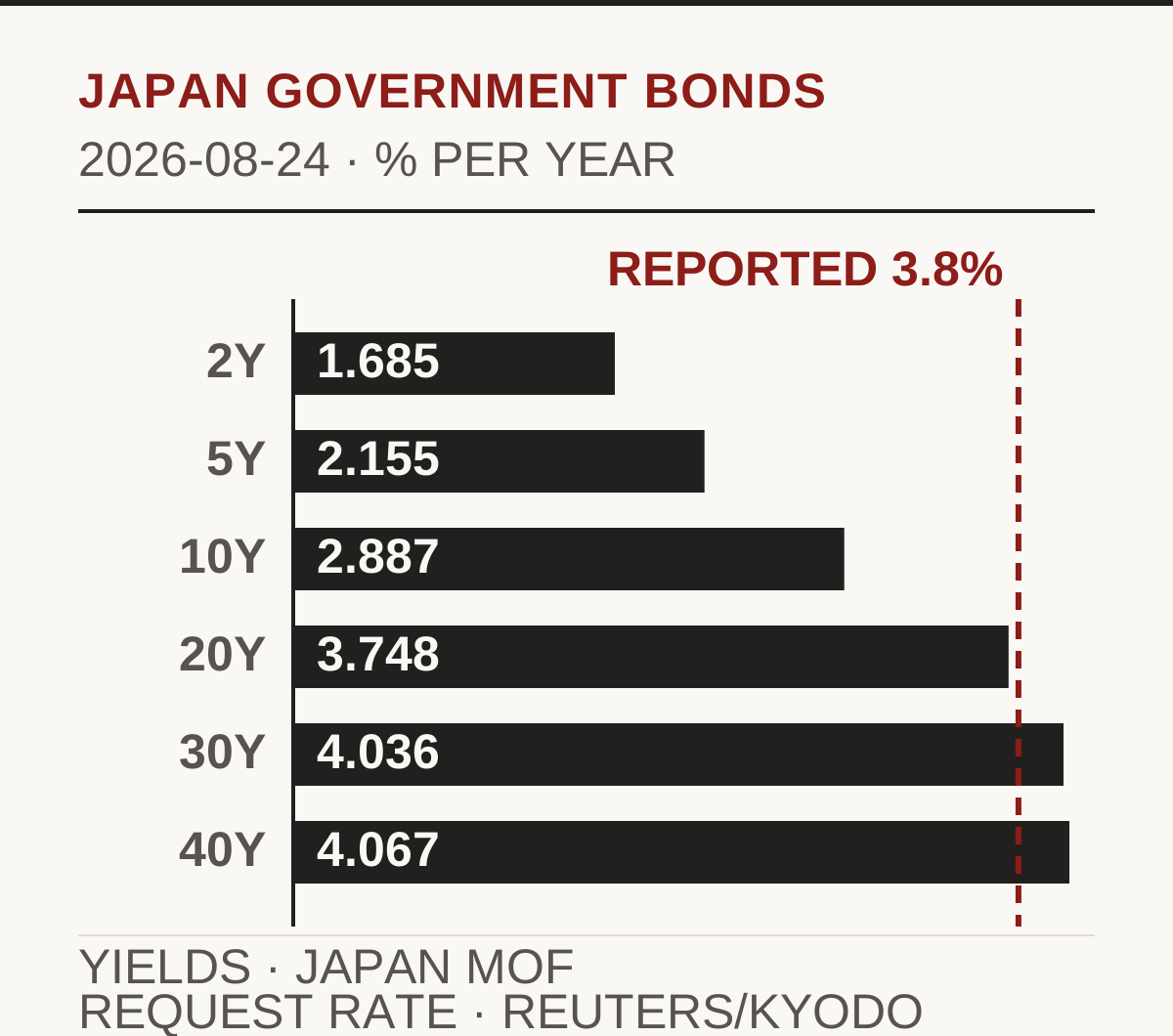
Whether 3.8% counts as aggressive depends entirely on which bond is meant. Against Monday's table it sits well above the ten-year and above the twenty-year, and below the thirty-year and the forty-year. For the long maturities that cost the most in interest per yen borrowed, the budgeting rate is already under what the market charges.
The other curve that moved this month is the American one. The Treasury's par yield table for that same 24 August has the US ten-year at 4.70% and the thirty-year at 5.23%. Line the two countries up maturity by maturity and the pickup for leaving Japan narrows at every step out the curve: 2.56 points at two years, 2.26 at five, 1.81 at ten, 1.46 at twenty, 1.19 at thirty. The reward for the longest duration is now the thinnest on offer, and it is thinnest exactly where Japan's own borrowing has become most expensive.
Where Japanese money actually sits is a question two published curves cannot settle, and nothing in either table says a yen has moved. What they do fix is the shape of the incentive, and the shape has been changing in one direction all year.
The requests are a ceiling, not a settlement. Kyodo's account puts total fiscal 2027 requests above ¥130 trillion for the first time, against roughly ¥122 trillion in this year's budget, and attributes the surge to Prime Minister Sanae Takaichi's expansionary fiscal policy — a public investment scheme among it — pursued without preset spending caps. Ministries ask for more than they get; requests are cut every year in the compilation that follows. Interest is the one line in the book that no one negotiates down.
What binds is not the request but the draft. The assumed rate that ends up in the budget is fixed with the draft budget in December — the fiscal 2026 budget was settled in the final week of December last year — and between now and then the ministry goes on publishing the market's own answer, every business day, on the page nobody reads.