
Three channels, one session: the tariff headline, the oil slip and the long end are not the same trade
Technology weakened, crude fell and pressure on long-dated paper eased within hours of each other. A trade dispute explains at most one of them. Here is what each mechanism actually rests on, and the three observations that would show this reading is wrong.

Monday offered a single, tidy story: a trade dispute was escalating, so technology shares fell, oil fell, and the pressure on longer-dated government bonds eased. The story is available and easy to tell, and for at least two of those three moves it is the wrong instrument.
Three separate mechanisms arrived in the same session. They have different origins, different speeds, and different things that would prove them wrong. A reader who folds them into one narrative loses the ability to test any of them.
The tariff channel is the narrowest of the three. The United States and Canada failed to reach a tariff agreement after several days of talks, each side blaming the other; 50% tariffs took effect on Saturday on roughly $20bn of Canadian goods, and Ottawa announced dollar-for-dollar retaliation over the weekend. That sequence is reporting by CNBC, not a measurement made here. Twenty billion dollars is a small slice of the bilateral trading relationship. So the mechanism is not the direct cost of the tariff. It is the price of escalation risk: talks that failed are information about the next round, and equity investors reprice a range of outcomes rather than the current invoice.
There is a sharper reason to keep this channel separate. The Federal Reserve's own account of its July meeting, released on 19 August, records that participants judged the pass-through of past tariff increases into the level of prices to be "now largely complete", and the effects of recently announced tariffs on measured inflation "likely to be modest". Whatever a reader makes of that judgement, it is the judgement the institution setting the policy rate is working from. On the Fed's reading, today's tariff news is an activity and margin story rather than an inflation story — a claim with a test attached, and the test is not the equity tape.
The oil channel runs on entirely different fuel. Oil fell on Monday while investors waited for what Washington has billed as its toughest sanctions campaign against Iran, with the package due to be presented later the same day; West Texas Intermediate was reported about 1.6% lower near $85.65 a barrel and Brent about 1.4% lower near $93.09. Those are reported market observations, carried here with attribution rather than restated as our own.
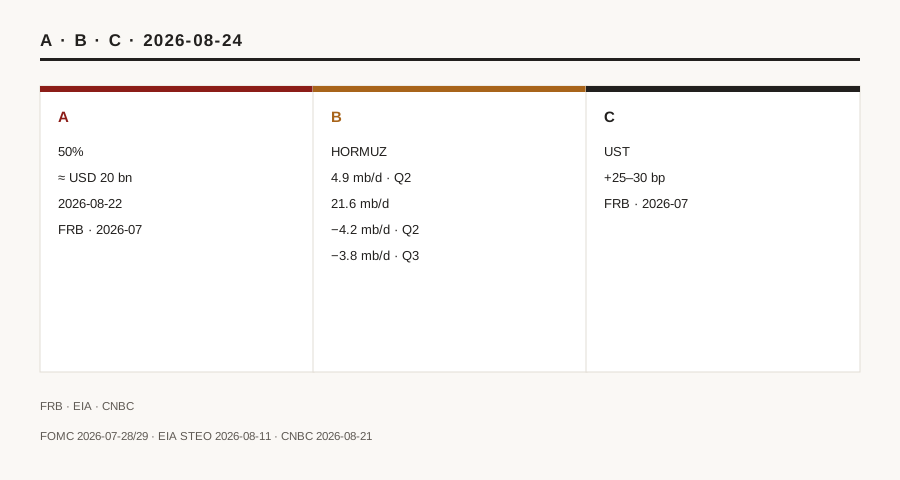
What can be checked at source is the physical background, and it is not a demand story. The Energy Information Administration's Short-Term Energy Outlook of 11 August records that global oil inventories fell by an average of 4.2 million barrels a day in the second quarter and projects a further average draw of 3.8 million barrels a day in the third. It records crude transport through the Strait of Hormuz averaging 4.9 million barrels a day in the second quarter, against 21.6 million before the conflict, and expects inventories to start building only once that traffic normalises and shut-in barrels return. Its Brent path averages about $85 a barrel in the third quarter, $78 in the fourth and $69 next year.
A market drawing down inventories at that rate does not soften because a list of Canadian goods became dearer. It softens when the risk premium attached to a specific announcement is marked down before the announcement lands. That is a different clock: it resolves in hours or days, on the content of the sanctions measures, not over the months a trade dispute takes to reach trade volumes.
The duration channel is the one most often mislabelled. The July minutes record that nominal Treasury yields rose 25 to 30 basis points over the intermeeting period, and state that the increase was "driven by increases in real yields" rather than by inflation compensation. The same account records reserves within a range consistent with ample supply, and continued Treasury bill purchases to keep them there. Reported levels put the 30-year yield near 5.28% after touching a nineteen-year high above 5.33% on 18 August; those levels are carried from market reporting and are not our own measurement.
If the long end is being priced on real yields, then "long-end pressure eased as oil fell" is an inflation-compensation sentence applied to a real-rate move. The two can coincide inside one session. They are not the same mechanism, and only one of them is what has actually been moving the long end this month.
Three things would prove this reading wrong, and each is checkable. First, if the next leg in long-dated yields arrives through inflation compensation rather than real yields, the tariff-as-inflation channel is live after all and the July judgement is dated. Second, if the oil move extends and holds after the sanctions detail is published, rather than reversing into it, the fall was a re-rating of supply and not anticipation. Third, if the front end moves with the long end, the story is the reaction function rather than supply and term compensation, and the axis used here is wrong.
None of that is a forecast. Nothing here says where any of these three markets goes next, and the channels can interact: a durable demand shock would eventually reach both oil consumption and real yields. The argument is narrower and more useful than a direction. On Monday the three had not yet converged, and a reader who kept them apart still holds three independent tests, while a reader who merged them into one trade holds none.