
The cushion under the largest digital dollar halved in a profitable quarter — and the incoming US stablecoin law was never written to watch it
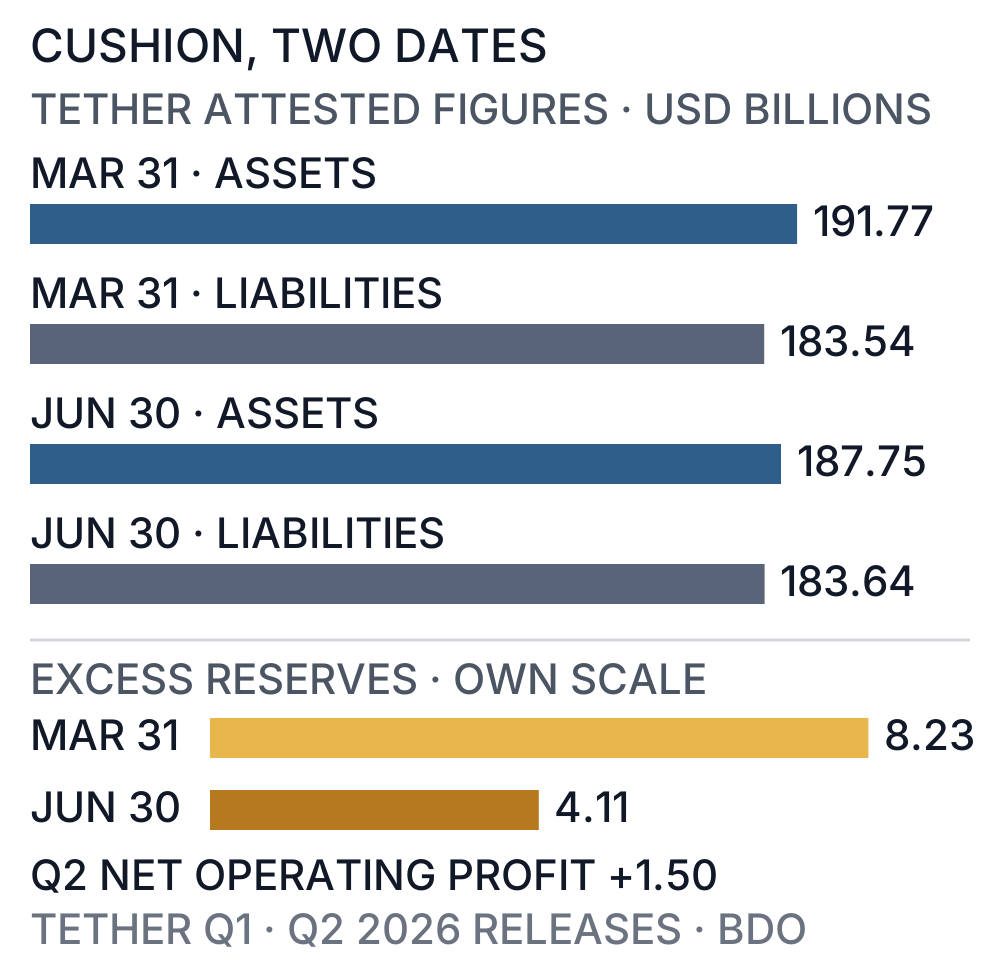
Tether's two most recent attestations put the excess reserves behind USDT at $8.23 billion on 31 March and $4.11 billion on 30 June — a quarter in which the company reports a $1.5 billion operating profit and does not say where the difference went. The GENIUS Act reaches full force in January 2027 requiring dollar-for-dollar assets, monthly certified disclosure and no yield to holders; it requires no cushion at all. What actually stands behind a redemption at scale now runs through the same Treasury bills the Federal Reserve's September decision is about to reprice.
Reporting sourcesTether — Q1 2026 attestation announcement, read at tether.io on 2026-09-02; BDO attestation dated 31 March 2026: total assets $191,767,741,495, total liabilities $183,535,531,717, excess reserves $8,232,209,778 described as an all-time high that would rank as the third-largest stablecoin in circulation on a standalone basis, roughly $141 billion of direct and indirect exposure to U.S. Treasury bills, the company's own description of itself as the 17th-largest holder of U.S. Treasuries globally, approximately $20 billion of gold and $7 billion of bitcoin, and a net profit of approximately $1.04 billionTether — Q2 2026 attestation announcement, read at tether.io on 2026-09-02; BDO attestation dated 31 July 2026 for the quarter ended 30 June 2026: total assets $187,751,426,411, total liabilities $183,641,897,215, excess reserves $4,109,529,196, approximately $184.6 billion of tokens issued, net operating profit of approximately $1.5 billion, physical gold above 146 tons after a 14-ton addition, a $2.38 billion (15 percent) reduction in secured lending, and a stated stablecoin market share above 60 percentTether — published fee schedule, read at tether.to on 2026-09-02: minimum redemption $100,000, redemption fee the greater of $1,000 or 0.1 percent, issuance fee 0.1 percent, redemption available to verified accountsCircle — transparency page, read at circle.com on 2026-09-02: the sentence 'USDC is always redeemable 1:1 for US dollars'; the Circle Reserve Fund (USDXX) described as an SEC-registered 2a-7 government money market fund managed by BlackRock; the remainder of the reserve held as cash among a handful of the world's largest banks; monthly attestations by Deloitte & Touche LLP, the most recent covering July 2026Bank for International Settlements — Working Paper No 1270, 'Stablecoins and safe asset prices', Rashad Ahmed and Iñaki Aldasoro, abstract read at source on 2026-09-02; on daily data from January 2021 to March 2026, a $3.5 billion two-standard-deviation stablecoin inflow lowers 3-month Treasury bill yields by 0.71 basis points on impact and up to 4 basis points within 10 days, with limited spillover to longer tenors and effects that strengthen with sector growth and amplify during Treasury market stressYesha Yadav and Brendan Malone — 'Stablecoins and the US Treasury Market', Journal of International Economic Law, volume 28 issue 4, December 2025, pages 665–688, read on 2026-09-02; Tether as the seventh-largest purchaser of US Treasuries in 2024 with $33.1 billion in net buys; collective stablecoin issuer Treasury holdings comparable to those of South Korea, Germany and Saudi Arabia; their account of the BIS finding that issuer purchases reduced the 3-month yield by 2–2.5 basis points while outflows produced an asymmetric increase of 6–8 basis points; and the observation that the run jeopardy banks meet with public deposit insurance has no stablecoin equivalentU.S. Department of the Treasury — proposed rule 'GENIUS Act Regulations on Payment Stablecoin Issuance, Offer, and Sale', Federal Register document 2026-16796, published 18 August 2026, comments due 19 October 2026; document identity and dates read from the Federal Register listing on 2026-09-02 after the full text refused automated retrievalEco — compiled reference 'What Is the GENIUS Act?', read on 2026-09-02: enactment as S.1582 on 18 July 2025; effect on the earlier of 18 January 2027 or 120 days after final implementing rules; reserves of at least the par value of tokens in circulation in US dollars, demand deposits, short-term Treasury bills and Treasury-backed repos; monthly published reserve composition examined by a registered public accounting firm and certified by the CEO and CFO; the prohibition on paying interest or yield to holders; and USDC circulation of $78.1 billion as of May 2026 citing DeFiLlamaEco — compiled reference 'USDC Reserves and How to Verify Them in 2026', read on 2026-09-02: the March 2023 record of USDC trading as low as $0.87 on Coinbase and Curve after Circle disclosed $3.3 billion of cash reserves at Silicon Valley Bank, about 8 percent of reserves then near $40 billion, with par restored within 72 hours of the FDIC guaranteeing the bank's deposits on March 12; and the characterisation of issuer attestations as agreed-upon-procedures reports rather than full auditsBoard of Governors of the Federal Reserve System — published 2026 FOMC meeting calendar, read directly at source on 2026-09-02; the September meeting is listed for the 15th and 16th

Two numbers, published four months apart by the same accounting firm about the same balance sheet, describe a quarter the world's largest stablecoin issuer summarises as a $1.5 billion profit.
On 31 March 2026, BDO's attestation of Tether's reserves recorded $191,767,741,495 of total assets against $183,535,531,717 of liabilities — an excess of $8.23 billion that the company's release called an all-time high, large enough, it noted, to rank as the third-largest stablecoin in circulation on a standalone basis. On 30 June the same exercise found $187,751,426,411 of assets against $183,641,897,215 of liabilities. The excess had fallen to $4.11 billion. The cushion between the holders of roughly $184.6 billion of USDT and any loss on what backs it halved in thirteen weeks.
Neither release reconciles the movement. A company that earns $1.5 billion in a quarter and ends it about $4.1 billion lighter has, by arithmetic, seen more than five and a half billion dollars leave through distributions, revaluations or both; the announcements itemise none of it. Nothing in the attested figures says the tokens were uncovered — at both dates assets exceed liabilities, which is what an attestation exists to state. What the two documents measure, precisely because they say so little else, is how thin the voluntary layer under the largest private dollar is, and how fast it can move without anyone being owed an explanation.
The balance sheet in question has become a Treasury-market object in its own right. Tether's March release claims roughly $141 billion of direct and indirect exposure to US Treasury bills and describes the firm as the 17th-largest holder of Treasuries in the world. Yesha Yadav and Brendan Malone, writing in the Journal of International Economic Law in December, put the sector's weight in sovereign terms: Tether alone was the seventh-largest purchaser of US Treasuries in 2024, with $33.1 billion in net buys, and stablecoin issuers collectively hold Treasuries comparable to South Korea, Germany or Saudi Arabia. Circle's USDC, the second pillar of the rail, circulated about $78.1 billion at the aggregator DeFiLlama's May reading. This is no longer a curiosity at the edge of the bill market; it is a buyer of sovereign scale whose federal reserve-asset rulebook does not bind until January, and which answers to redemption on demand.
All of the yield this collateral throws off stays with the issuers — first by construction, soon by statute. Tether's $1.5 billion quarter was earned on a reserve its release describes as centred on short-duration, high-quality liquid assets, the majority in US government-backed instruments; Circle's model is the same float. The GENIUS Act, signed in July 2025 as S.1582, prohibits a permitted issuer from paying any form of interest or yield to holders for holding the token, and the OCC's proposed implementing rules would stretch that prohibition to affiliates and third parties. A bank shares its float with depositors because law and competition force it to. This rail, by design and soon by law, does not. The holder's entire compensation is the rail itself — which makes the integrity of the par promise the whole of the product.
And the promise of par is two very different machines. Circle's is the conservative build: 'USDC is always redeemable 1:1 for US dollars,' its transparency page says, with reserves held mainly in the Circle Reserve Fund — an SEC-registered 2a-7 government money market fund, ticker USDXX, managed by BlackRock — the remainder as cash among a handful of the world's largest banks, and a Deloitte & Touche attestation published monthly, most recently for July. Tether's window is narrower: redemption runs through a verified account, carries a minimum of $100,000 and costs the greater of $1,000 or 0.1 percent. A holder below the minimum, or outside the verification perimeter, does not redeem at all. They sell, at whatever an exchange will pay.
That split is the load-bearing fact of this market, and it is why 'the peg' is a misleading singular. For the institutional tier there is an at-par window that converts tokens into a claim on bills and bank cash. For everyone else, the dollar value of a stablecoin is an exchange price that merely tends to stay near one. Nothing holds the two together except institutions choosing to arbitrage them, and the stressed hour is defined as the hour in which they hesitate.
The reserve reports both issuers publish are attestations, not audits. They are agreed-upon procedures: an accounting firm confirms that on one stated date the asserted assets matched the asserted categories. Between dates, and on anything the assertion does not cover — encumbrances, operational access, what the assets would fetch in size on a bad day — the documents are silent by construction. That is not a scandal; it is the stated scope. It does mean a market's continuous confidence rests on a discontinuous measurement, taken quarterly at one issuer and monthly at the other. Tether does have an audit, but it is a separate document covering a separate period: the company reported in August that KPMG US had completed a full audit of its 2025 annual financial statements — the year to 31 December 2025 — and issued an unqualified opinion. Neither the March nor the June reserve figure read here is an audited number.
The one full-scale test of the market machine happened, inconveniently for tidy conclusions, to the conservative issuer. In March 2023, when Silicon Valley Bank failed holding $3.3 billion of Circle's cash — about 8 percent of reserves then near $40 billion — USDC traded as low as $0.87 on Coinbase and Curve, and returned to par within 72 hours of the FDIC guaranteeing the bank's deposits. Read closely, that sequence is unflattering to every layer of the plumbing at once: a sliver of the reserve repriced the entire float; the redemption window could not carry a weekend; and par came back not from the reserve but from a public backstop. Yadav and Malone's observation lands exactly here — the run jeopardy that banking meets with deposit insurance has no stablecoin equivalent. What stands in for it is the quality of the assets and whatever excess sits above the liabilities. Which returns the eye to a cushion that just halved.
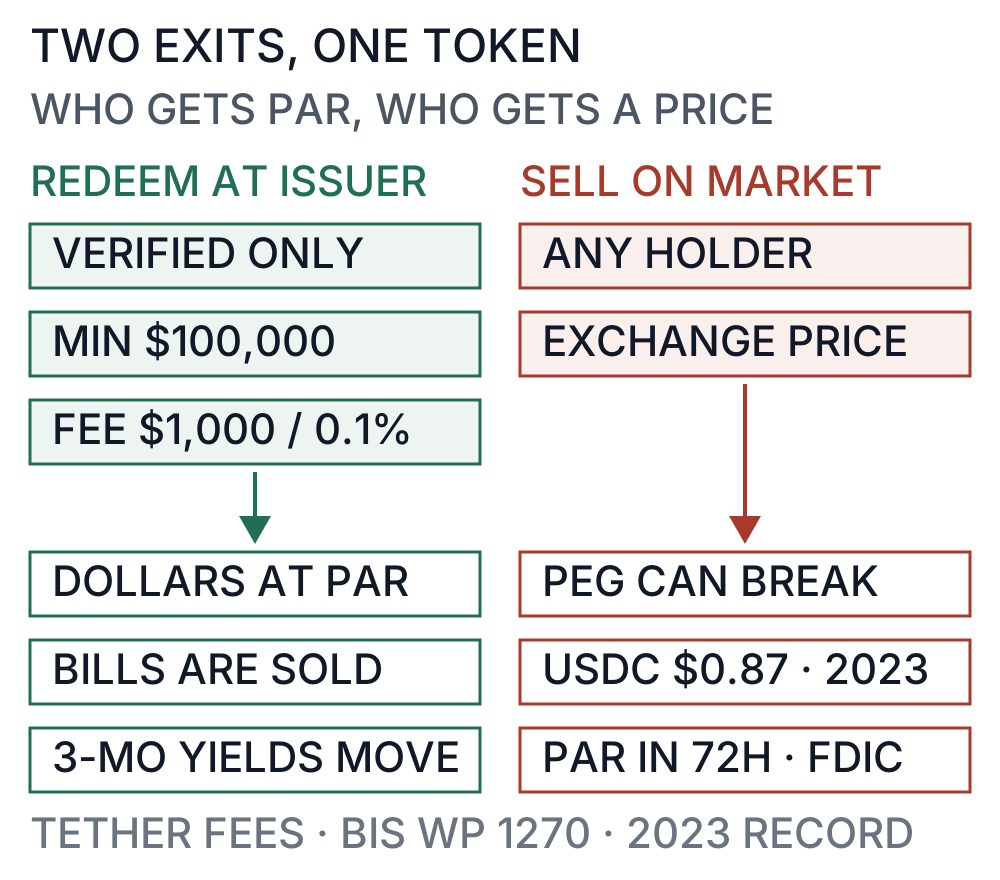
The channel into the bill market is measured, not hypothetical. Rashad Ahmed and Iñaki Aldasoro at the Bank for International Settlements, on daily data from January 2021 to March 2026, find that a $3.5 billion inflow into dollar stablecoins lowers 3-month Treasury yields by 0.71 basis points on impact and up to 4 basis points within ten days, with little spillover to longer tenors — effects that, on their evidence, strengthen as the sector grows and amplify during Treasury market stress. Yadav and Malone's account of the BIS work carries the more consequential half: outflows push the yield up by 6 to 8 basis points, more than twice the inflow effect. The plumbing forgives growth and punishes redemption, because minting buys bills at leisure while redemption sells them on somebody's deadline. A rail that accumulated $141 billion gradually and would shed it suddenly is not a neutral presence in a stressed front end — and this autumn the front end has other business, with the Federal Reserve's decision of 16 September repricing exactly those maturities.
For crypto markets the transmission is more intimate. Tether states its share of the stablecoin market above 60 percent; a float that large sits on one side of most of crypto's prices. Because the sub-$100,000 holder exits on-market, redemption stress in this system does not first appear as a queue at the issuer's door. It appears as a discount on the exchange price, and the discount reprices every asset quoted in the token in the same minute. That is what March 2023 actually looked like: the visible instruments of stress were a Curve pool and the Coinbase order book, not a redemption desk. A USDT version of that hour, at more than twice USDC's float and with the majority of the market quoted in it, is the scenario the cushion exists for — and the cushion is what shrank.
The law that will govern all of this is enacted and not yet in force. The GENIUS Act takes effect on the earlier of 18 January 2027 or 120 days after the primary federal regulators finalise their rules; Treasury published its proposed rule on stablecoin issuance, offer and sale on 18 August with comments open to 19 October, which settles the arithmetic — no rule finalised after that close can start a 120-day clock that beats mid-January. When the statute binds, a permitted issuer's reserves are dollar-for-dollar in cash, insured deposits, short-dated Treasury bills and Treasury-backed repos; composition is published monthly on the issuer's own site, examined by a registered public accounting firm, and certified personally by the chief executive and chief financial officer.
Two things about that list matter more than its severity. It contains no buffer requirement: a compliant issuer may run at exactly one-to-one, because the statute polices what the assets are, not how much extra stands behind them. The number the market watches is invisible to the law. And the list has no room for what grew while the cushion shrank. Tether added 14 tons of gold in the second quarter, taking the position above 146 tons, alongside a bitcoin holding and a secured-loan book it says it cut by $2.38 billion, or 15 percent. At the March attestation the gold and bitcoin together stood near $27 billion — several times the June cushion. Every ounce and every coin is a revaluation exposure sitting where the incoming list of permitted reserve assets does not reach. The five months to January are the window in which that tail has to go somewhere: into a separated structure for a US-eligible token, out of the reserve entirely, or nowhere — which would itself be an answer about which markets the issuer intends to serve.
None of this compels a sinister reading, and the benign one is easy to state. The tokens were covered on both dates, on the attested numbers, and the float did not flee — total liabilities were slightly higher at the end of June than at the end of March. A private company distributing profit, or riding the marks on assets it chooses to hold, breaks no rule that exists now and none that January brings. The secured-lending cut points in the direction the statute leans. And the measured yield effects are single-digit basis points in a bill market that digests the Treasury's own refunding cycles; on the BIS numbers, no plausible stablecoin redemption day has yet moved the front end more than a few basis points. If the next attestation rebuilds the cushion, or simply explains it, the thin-layer reading of this quarter closes on the spot — a quarter of housekeeping that merely went unexplained.
Every open question here carries a date. The attestation after September's close either itemises where four billion dollars went or repeats the silence. Treasury's final rule fixes the real shape of the January regime, including how much of Tether's balance sheet can ever stand behind a US-permitted token. And the next afternoon of genuine outflow will show whether redemption still costs the bill market more than twice what growth earns it. The rail's promise is that a dollar which pays its holder nothing is still worth a dollar on demand. For five more months the continuous evidence for that promise is an exchange price, and the discontinuous evidence is a quarterly number that just halved.