
An overnight operation with no published rate is plumbing, not a policy turn
Beijing's seven-day operation states its price every time; the newer overnight one states only a ceiling. Reading the difference correctly separates the policy rate, the quantity of short-dated cash and the cost of credit into three questions instead of one.

A central bank that changes the amount of overnight cash in the banking system has not changed the price of money. Those are two different instruments, they are announced in two different ways, and telling them apart is most of the work of reading Chinese liquidity operations correctly.
Start with what the People's Bank of China published on 24 August. Its open market trading announcement, numbered 163 for the year, records a seven-day reverse repurchase operation of 340 billion yuan, conducted by fixed-rate, quantity tender at an operating rate of 1.40%, fully meeting the bids of primary dealers. Every element of that sentence carries information. The tenor is seven days. The rate is stated. The bank set the price and allowed the quantity to be determined by what dealers asked for.
That rate is the one to watch. The seven-day reverse repurchase rate is the operating target the bank has designated as its main policy rate, which is why it is disclosed in every trading announcement and why the number is unremarkable only when it does not change. On 24 August it did not change.
Now put the newer instrument beside it. On 12 August, China News Service reported that the bank would conduct overnight reverse repurchase operations on 14 August and again from 17 to 19 August, by fixed-rate, quantity tender, with daily volume not exceeding 600 billion yuan, in order to better match the short-term liquidity needs of the banking system; the bank's own notice of that schedule was not located on its open market announcement index, so the schedule is carried from that report. In the description the report carries, an overnight operation can shave the peaks and fill the valleys at particular points in the calendar, improving the efficiency of liquidity management and lowering costs for financial institutions. People's Daily Online reported on 27 July that the bank would run overnight operations across several days that month as well; that earlier round is carried from reporting rather than read here at source.
Three features of the overnight instrument matter, and none of them is a rate signal.
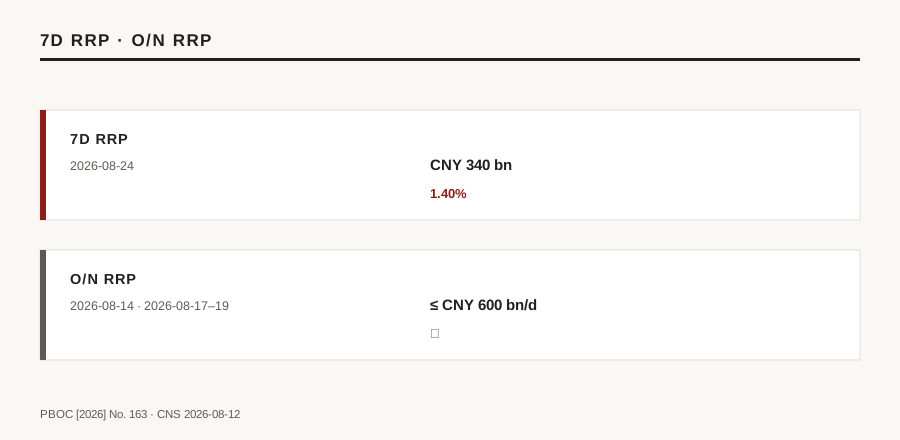
First, the price is not disclosed. A tender whose result is announced without a rate cannot be a statement about where the bank wants money priced, because the statement is missing. The seven-day announcement discloses its rate every time; the overnight notice does not.
Second, the ceiling is a control, not a target. "No more than 600 billion yuan a day" is an upper bound on how much the bank is prepared to supply if dealers ask for it. A cap that is never reached tells a reader that demand was smaller than the bank's willingness, which is the opposite of a stimulus announcement.
Third, an overnight tenor cannot carry a term signal. Money lent for one night is repaid the next morning. It can smooth a tax payment date, a bond settlement date or a quarter-end ratio date; it cannot express an intention about funding conditions three months out, because it has expired long before then. That is precisely why these operations cluster around particular dates rather than running continuously.
The practical reading, then, separates three questions that are often merged into one. Has the price of policy money changed? Look at the seven-day operating rate in the trading announcement. Has the quantity of short-dated liquidity changed? Look at operation sizes and at whether the overnight instrument is being used at all. Has the cost of credit to borrowers changed? Look at the loan prime rate, which is published on its own monthly schedule and was last published on 20 August.
Four observations would change this reading, and each is checkable in the bank's own publications. If the seven-day operating rate moves, the policy rate has moved and the quantity story is secondary. If the loan prime rate moves without a change in the operating rate, the transmission step rather than the stance is being adjusted. If overnight operations continue away from month-end and quarter-end dates, and at size, the instrument has become something other than smoothing. And if the bank starts disclosing an overnight rate, it has chosen to make that operation speak about price after all.
Nothing here is advice about positioning in Chinese rates or anywhere else, and nothing here forecasts the next operating rate. The claim is narrower: a quantity operation with an undisclosed price, a daily ceiling and an overnight tenor is designed to keep the plumbing quiet, and a reader who treats each such notice as a policy turn will keep finding signals that the publishing institution did not send.