
Warsh's Jackson Hole debut and the payroll benchmark revision land in the same minute — this week resolves in two instants, not five days
Wednesday 08:30 and Friday 10:00 New York time carry almost everything the week decides. The July minutes already recorded a committee arguing about hikes, which is not what a soft dollar, a three-month high in gold and a firm bitcoin are positioned for. Here is the transmission channel, the counterargument, and what would break each reading.

Asia trades this week's two decisive moments after its own close, and each of them is shorter than a lunch break.
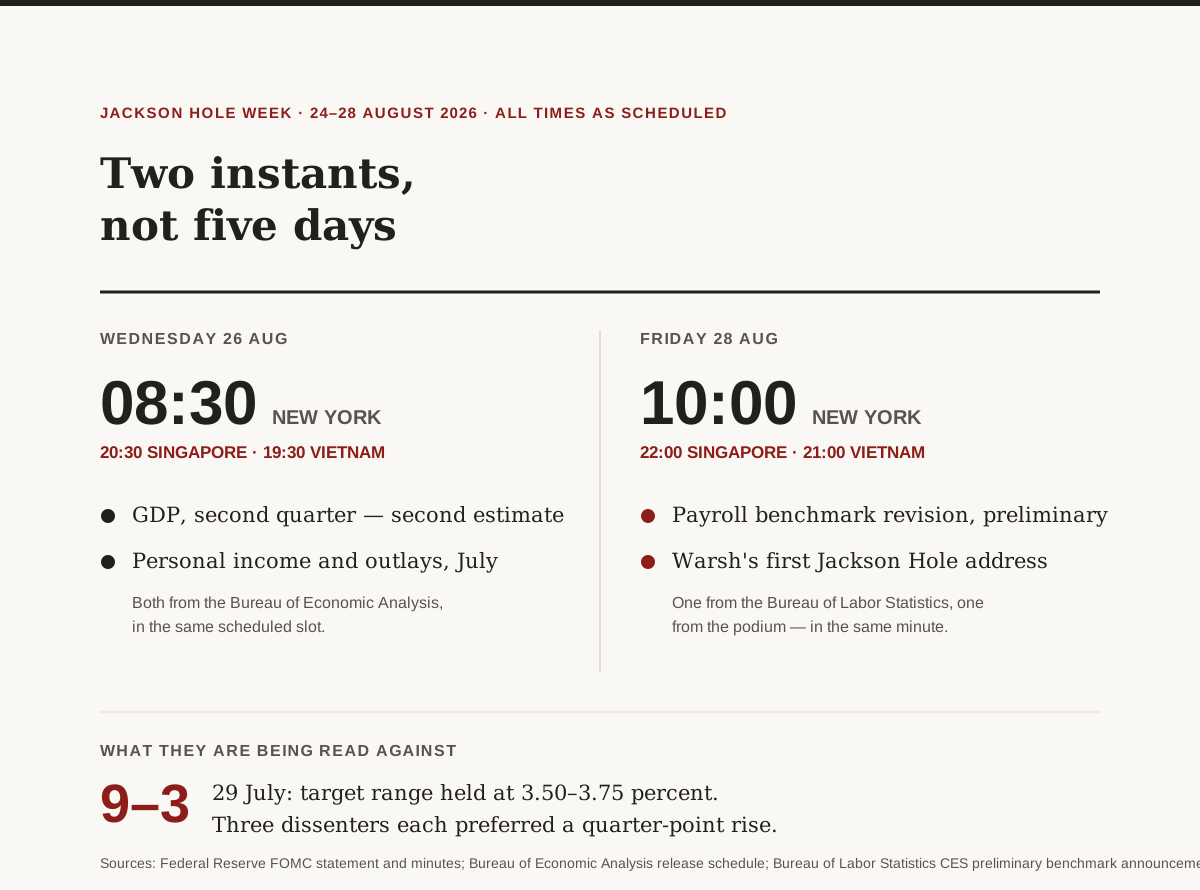
At 08:30 in New York on Wednesday — 20:30 in Singapore, 19:30 in Ho Chi Minh City — the Bureau of Economic Analysis publishes the second estimate of second-quarter GDP with corporate profits, and July personal income and outlays, in the same slot. At 10:00 on Friday — 22:00 in Singapore — the Bureau of Labor Statistics publishes the preliminary estimate of the annual benchmark revision to the establishment survey, and Kevin Warsh begins his first Jackson Hole address as Federal Reserve Chair. Not on the same day: in the same minute.
That collision is the story, because the two events approach one question from opposite ends. The speech is the clearest statement yet of how a new Chair intends to react to incoming data. The benchmark revision changes the data he is reacting to. Anyone who has spent August pricing a reaction function receives both readings simultaneously, with no interval in which to price one before the other arrives.
What the market is carrying into it is not subtle. The 30-year Treasury yield rose above 5.3% on 18 August, the highest since 2007, while a 10-year auction cleared at 4.68% and a 30-year auction at roughly 5.22%, the highest since 2021; federal debt is approaching $40 trillion and the July deficit was $432 billion, figures reported by The Fiscal Times. Against that backdrop the cross-asset move went the other way. After the Treasury Department raised the size of its long-dated buyback operations mid-quarter — to $4 billion or more per operation from $2 billion, running 9 September to 4 November, as CoinDesk reported from the refunding documents — The Business Times reported that the yield relief lasted about a day while the dollar weakened, gold reached a three-month high and bitcoin traded near $77,000 by Friday 21 August, with long-dated Treasuries roughly flat on the week. CoinDesk reported XRP up 51% since that Monday, at $1.50.
Read the tape literally and one story is being told: official Washington will not tolerate a disorderly long end, therefore real yields are capped, therefore hold the assets that benefit when the currency does the adjusting.
The first thing that reading has to survive is a distinction between institutions. A buyback is financed by issuing other Treasury securities. No central-bank balance sheet expands and no bank reserves are created, so it is not quantitative easing; and it is not yield-curve control, which requires a declared level and an open-ended commitment to defend it. What it genuinely does is retire less-liquid off-the-run paper and, where long bonds are repurchased and funded further down the curve, take a slice of duration off private balance sheets. That is a real effect with a hard ceiling — the programme's own size, set against a deficit of the order above — and it is an action by the issuer, not a change in the reaction function of the central bank.
The Federal Reserve's own record points the other way. On 29 July the Committee held the federal funds target range at 3-1/2 to 3-3/4 percent on a 9-3 vote, with Beth M. Hammack, Neel Kashkari and Lorie K. Logan each preferring a quarter-point increase. The minutes released on 19 August record that many participants judged that "policy tightening would likely be necessary if inflation did not decline", and that some considered financial conditions possibly not restrictive enough to return inflation to target. The same minutes note nominal Treasury yields rising 25 to 30 basis points over the intermeeting period, driven by real rates, and reaffirm the policy of maintaining ample reserves in the banking system.
A committee whose dissenters want to raise rates is not the committee implied by a debasement trade. Both can hold for a while — the long end can be a fiscal and supply story while the front end is a hawkish one — but they cannot both be a statement about the same reaction function.
The second mechanism is easier to misread, because a benchmark revision sounds like a technicality. It re-levels the establishment survey against unemployment-insurance tax records through March 2026. It does not restate the current month's job flow; it restates the level from which every subsequent month has been measured. A large downward preliminary estimate would mean the labour market entering this year had less momentum than the published series showed, which strengthens every argument that policy is already restrictive. A small or upward one removes the most convenient explanation available to anyone arguing for cuts, and leaves the July dissent looking better informed.
That is why the 10:00 collision matters rather than merely being untidy. The revision arrives as the Chair speaks, so his words will be read through a labour-market picture that changed in the same instant — and, on the record available, without his having been able to reference it.
Three objections deserve to be stated at their strongest. First, the symposium's own topic this year is financial innovation and its implications for payments and policy; a Chair speaking to that programme may deliberately carry no rate signal at all, and a market braced for one would then be trading its own expectation rather than his. Second, if the long end is being driven by issuance, deficits and corporate financing demand rather than by the expected policy path, the reaction function is not the operative variable, and the debasement trade can be right for reasons that have nothing to do with Wyoming. Third, Wednesday's personal income and outlays release lands two days earlier; if the inflation reading is decisive in either direction, much of Friday's tension may already be spent before anyone speaks.
The combinations are more informative than any single outcome. A firm July core inflation reading on Wednesday, followed by a Chair who declines to soften the July language, leaves the dissenters vindicated and the debasement trade holding an asset mix priced for the opposite reaction function. A soft reading followed by a large downward benchmark revision produces the mirror image, and would be the first genuine evidence this month that the front end and the long end are telling one story. A soft reading with a small revision and a speech confined to payments is the awkward case: nothing is confirmed, positioning is unwound by no one, and the burden simply moves to the September meeting.
So what would break each reading? Four observations, each checkable against the releases themselves.
For the debasement reading to survive the week, the long end has to hold its recent range while the dollar stays soft after Friday's address. It is broken if the dollar firms and gold gives back its August gain on hawkish language, because that would show the position was an expectation about the central bank rather than a judgement about the fiscal path.
For the hawkish reading, the test is narrower. It requires the July core inflation reading not to fall and it requires no large downward benchmark revision. Either of those alone weakens it materially; both together break it.
For the claim that the Treasury has capped the long end, the falsifier is the most measurable of the three: 30-year yields making a new high above the 18 August level while buyback operations are running. Those operations begin on 9 September, so that specific test is not available this week — which is itself a reason to distrust confident claims about it before then.
And for the assumption that the speech is the week's main event, the falsifier arrives first: if Wednesday's two releases move the long end more than a percentage-point-scale surprise in the revision would, the reaction function was never the binding constraint, and the market has been watching the wrong podium.
None of this is a recommendation to take or avoid a position. It is a set of observations that will exist by Friday evening in Asia, each of which a reader can check against the official releases rather than against anyone's account of them.