
One workforce, two ledgers: what Friday's jobs report can actually settle
At 12:30 UTC on Friday the Bureau of Labor Statistics publishes the August Employment Situation — the only labour evidence the Federal Reserve receives before its 16 September vote. For six months the report's two surveys have disagreed: the unemployment rate has fallen from 4.4 to 4.1 percent while payroll growth has averaged twenty thousand a month and turned negative in July. A shrinking workforce reconciles them. The number to take seriously on Friday is whichever one ends the disagreement.
Reporting sourcesU.S. Bureau of Labor Statistics — official 2026 release schedule for September, as verified for the desk's 2 September research package; the Employment Situation for August 2026 is listed for Friday 4 September at 8:30 a.m. ET, with the Producer Price Index on the 10th and the Consumer Price Index on the 11thU.S. Bureau of Labor Statistics — public data API v2, series CES0000000001 (total nonfarm payrolls), LNS14000000 (unemployment rate), LNS11300000 (labour force participation), JTS000000000000000JOL, JTS000000000000000HIL and JTS000000000000000QUR (job openings, hires, quits rate), as queried and recorded for the desk's 2 September research package; every payroll change, rate, participation and openings figure in this dossier is that response or arithmetic on itBoard of Governors of the Federal Reserve System — published 2026 FOMC meeting calendar, as re-read for the desk's 2 September research package; the September meeting is listed for the 15th and 16th with a Summary of Economic ProjectionsBoard of Governors of the Federal Reserve System — FOMC statement of 29 July 2026, as verified for the desk's 2 September research package; target range 3-1/2 to 3-3/4 percent on a 9-3 vote, with Beth M. Hammack, Neel Kashkari and Lorie K. Logan dissenting in favour of a quarter-point increaseBoard of Governors of the Federal Reserve System — Summary of Economic Projections, 17 June 2026, Table 1, as verified for the desk's 2 September research package; the 4.3 percent median for the end-2026 unemployment rate and the 3.8 percent median for the end-2026 federal funds rate, against 3.4 percent in MarchU.S. Department of the Treasury — Daily Treasury Par Yield Curve Rates, 2026 series, as recorded for the desk's 2 September research package; the two-year par yield of 4.20 percent on 27 August and 4.39 percent on 1 September

The Employment Situation is one document assembled from two separate interviews. The establishment survey asks employers how many people were on their payrolls; the household survey asks people whether they are working or looking. The first produces the payroll count, the second the unemployment rate, and in an ordinary month the distinction is a footnote. On Friday 4 September at 8:30 in Washington — 12:30 UTC on the Bureau of Labor Statistics' published schedule — the distinction is the whole story, because the two ledgers have spent half a year describing different labour markets.
The establishment ledger reads as a stall. After a fall of 156,000 in February, payrolls rose 214,000 in March, 148,000 in April, 63,000 in May and just 20,000 in June, then fell 23,000 in July. The three-month average is twenty thousand a month. The household ledger reads as strength: unemployment at 4.4 percent in February, 4.3 through the spring, 4.2 in June and 4.1 in July — a level already below the 4.3 percent the Federal Reserve's June projections pencilled in for the end of the year.
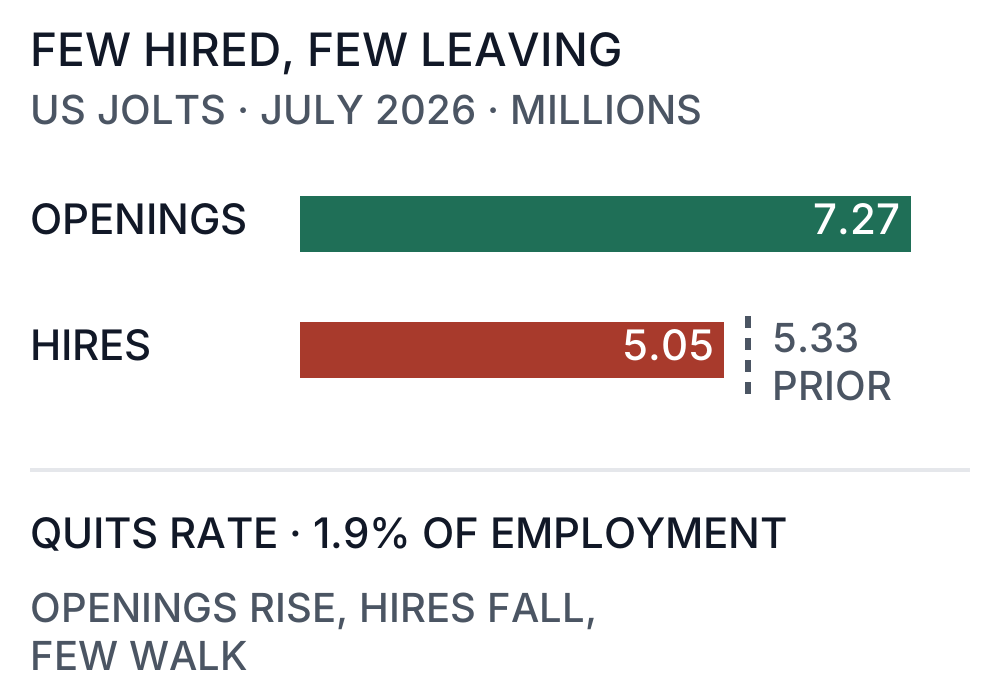
Participation is the hinge between them. The share of the population working or looking for work stood at 62.5 percent last November and 61.4 percent in July. The unemployment rate has been falling because the workforce is shrinking faster than employment, not because hiring is strong, and the July job-openings survey describes the same economy from a third angle: openings at 7.27 million and rising, hires at 5.05 million, down from 5.33 million, and a quits rate of 1.9 percent. Employers advertise, few are hired, and almost nobody walks. A labour market in that state is frozen rather than failing — and a frozen market can print a falling unemployment rate on the way into trouble just as easily as on the way out of it, which is why the rate on its own has stopped carrying information.
Those numbers land eleven days before the Federal Open Market Committee meets with a fresh projection round. In July the Committee held the target range at 3-1/2 to 3-3/4 percent on a 9-3 vote, with Beth M. Hammack, Neel Kashkari and Lorie K. Logan each preferring a quarter-point increase; between March and June its median expectation for this year's funds rate moved from 3.4 to 3.8 percent — from cutting to raising. Friday's print is the first of only three pieces of hard evidence to arrive before that vote, with producer prices on the 10th and consumer prices on the 11th behind it. The Committee's own inflation gauge for August comes on 30 September, after the meeting.
Two mechanical points frame the release. It carries revisions for June and July alongside the first August estimate, so the −23,000 that anchors the stall reading is itself still provisional and can move within the same document. And the unemployment rate can fall for a good reason — more jobs — or an uncomfortable one — fewer people looking; only the participation line says which.
The meaningful surprise on Friday would be agreement. If payrolls print clearly positive while the rate holds or falls with participation steady, the freeze reading dies on the spot: the labour market is simply strong, and eleven days before a projection round whose median already sits above the current target ceiling, that is a hawkish document. If instead the payroll count falls again and the unemployment rate finally rises with it, the divergence resolves the other way and the three July dissents lose their footing. Another split month — a negative count under a falling rate — extends the argument rather than ending it, and leaves the projections to arbitrate. The quietly decisive figure would be a turn in participation itself, the only line that can make the two ledgers honest with each other again.
The rates market has already moved. Between 27 August and 1 September the two-year Treasury yield rose from 4.20 to 4.39 percent on the Treasury's daily table — nineteen basis points priced off an oil shock, with no labour evidence behind them. Friday is the first release with the standing to ratify that move or unwind it: a print that ends the surveys' disagreement, in either direction, is the kind that redraws the September projections, while another month of disagreement moves positions, not policy.
The report will not supply the index the Committee's target is written on — that number arrives on 30 September, after the vote — and one morning of data will not fully unwind a divergence six months in the making. It is still the only labour reading the Committee gets before it votes. Read the payroll change and the unemployment rate against each other, and read the participation line before either: it is the number that decides whether the two ledgers finally answer the same question.