
No bears left: US stocks head into a historically turbulent midterm window
BofA's August survey finds equity positioning at five-year extremes — past the bank's own sell-signal thresholds — just as the market enters the hardest stretch of midterm-election years.

Bank of America chief investment strategist Michael Hartnett says global fund managers' equity allocations have climbed to their highest in nearly five years, and market consensus is becoming dangerously crowded.
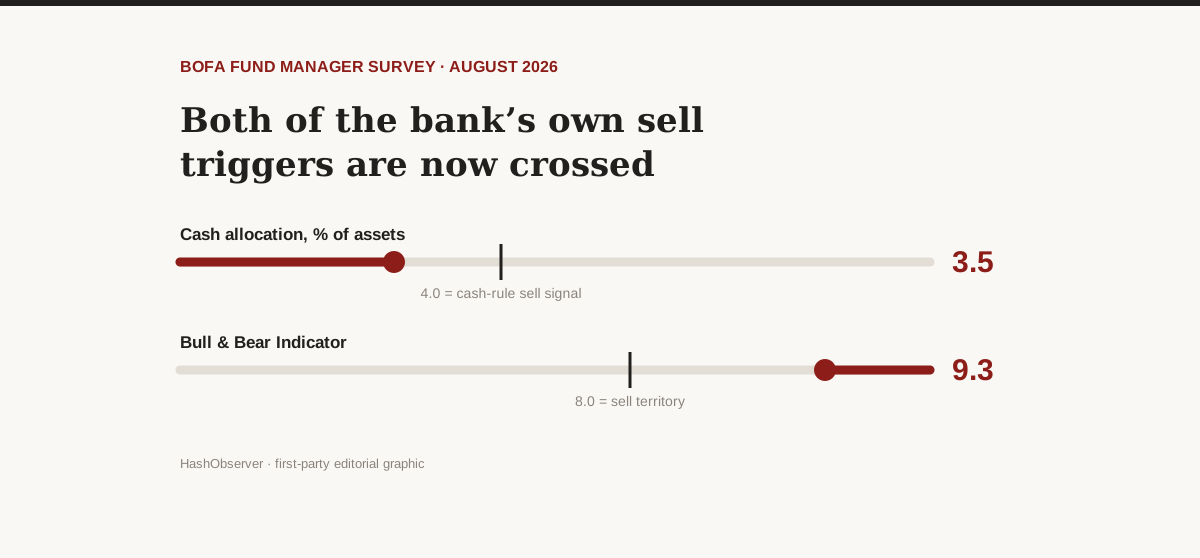
BofA's August Global Fund Manager Survey shows a net 56% of respondents overweight equities, the most since November 2021 and the fourteenth consecutive month of overweight positioning; cash allocations have fallen to 3.5%, a historic low.
Those levels carry a specific meaning inside the bank's own framework. Under Hartnett's long-standing cash rule, allocations at or below 4% generate a sell signal for risk assets. BofA's separate Bull & Bear Indicator now reads 9.3, above the 8.0 level that has historically marked sell territory.
The survey ran from August 7 to 13 and polled 180 fund managers overseeing a combined $525 billion. BofA called it the third most bullish investor-sentiment reading since 2022.
Hartnett's team summarized the consensus as "no macro landing, no Fed hike, no AI capex cut, no DEM sweep, no bears" — adding that positioning "continues to recommend investors retreat or rotate within risk assets rather than reload."
Optimism about the economy sits at cycle extremes: a record 56% of respondents expect a "no landing" scenario and 43% forecast an outright boom, the most since February 2022. 72% expect no Fed hike before the November midterms.
Long global semiconductors remains the most crowded trade, though its share fell sharply to 53% from 82% last month. An AI bubble is viewed as the biggest tail risk, with hyperscaler capital spending seen as the most likely source of a credit event.
Even so, 71% expect no hyperscaler to cut AI capex this year, and 58% think AI will not visibly hit the job market until at least 2028.
BTIG chief market technician Jonathan Krinsky argues the market's strength does not mean risk has passed. The S&P 500 is up more than 13% this year and the equal-weight index about 16%; both recently set record highs, and nearly every major sector is positive for the year.
Krinsky notes that August 18 through October 11 is typically one of the hardest stretches of US midterm-election years. Midterms themselves are not necessarily bearish; the trigger has usually come from outside shocks — Iraq's 1990 invasion of Kuwait, or the 2014 Ebola outbreak.
Per the history Krinsky cites, in every midterm year since 1990 except 2006 the S&P 500 fell at least 7% between August and October. With stocks at record highs and volatility at year-to-date lows, concern about investor over-optimism is mounting.
The bond market is signalling pressure too: 10-year Treasury yields sit above 4.7% and the 30-year above 5.2%. Higher funding costs, plus Middle East energy-price risk, could become fresh headwinds for equities.
Krinsky sees healthcare as a defensive option — up more than 15% over three months, among the best-performing sectors — and suggests trimming exposure or hedging into this historically difficult window.