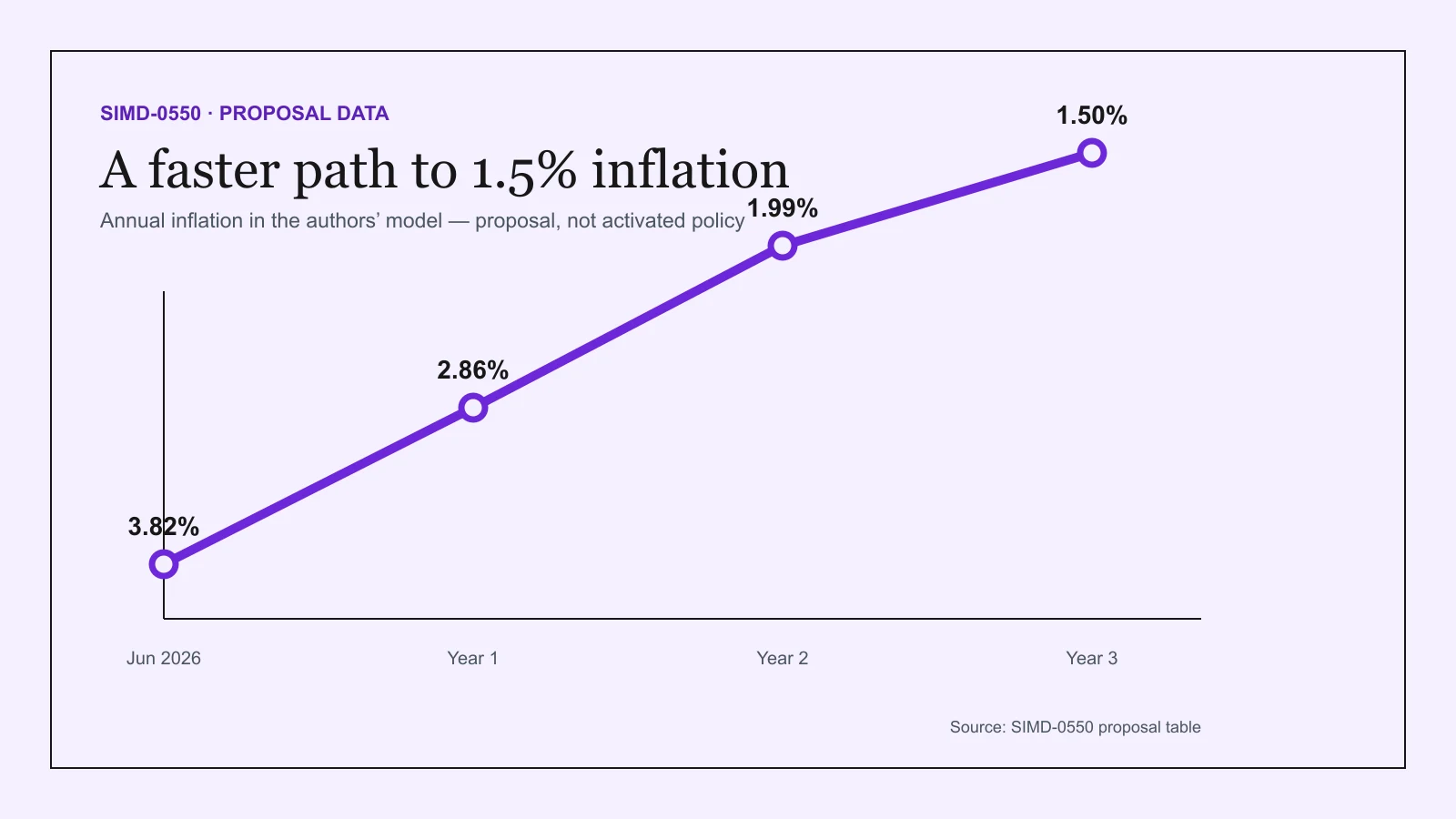
Solana's current schedule reduces the inflation rate by 15% each year until it reaches a 1.5% terminal rate. SIMD-0550, posted by Helius contributors, would double that disinflation rate to 30%. Under the authors' table, inflation falls from 3.82% in June 2026 to 2.86% after one year, 1.99% after two years and 1.5% after three.
A faster descent to the 1.5% inflation floor
That distinction matters because some coverage describes the proposal as a larger burn. The mechanism in the primary document is accelerated disinflation: fewer new SOL would be issued. Transaction-fee burning is a separate part of Solana's monetary system.
The proposed inflation path
- June 2026
- 3.82 % annual inflation
- Year 1
- 2.86 % annual inflation
- Year 2
- 1.99 % annual inflation
- Year 3
- 1.5 % annual inflation
Method: Proposal model, not an adopted network schedule. The terminal rate remains 1.5%.
Modeled annual inflation rates
| Checkpoint | Current schedule | SIMD-0550 |
|---|---|---|
| June 2026 | 3.82% | 3.82% |
| Year 1 | 3.24% | 2.86% |
| Year 2 | 2.75% | 1.99% |
| Year 3 | 2.33% | 1.50% |
| Year 6 | 1.50% | 1.50% |
Validator income under lower issuance
At 68% staking participation, the authors model nominal staking yield falling from 5.84% today to 4.34% after one year, 3.00% after two and 2.25% after three. Holders who do not stake would face less dilution, while validators and delegators would receive fewer newly issued tokens.
The proposal's validator model estimates that two of 738 sampled validators become unprofitable in year one, 13 in year two and 30 in year three. Those numbers are scenario outputs, not observed future failures. Hardware, voting costs, commission rates, stake concentration and SOL's market price can all change the result.
The governance decision
Supply
The authors estimate 18.9 million fewer SOL issued over six years, equal to 2.6% of modeled supply.
Validator distribution
Average profitability can remain positive while smaller operators lose margin first.
Security budget
A lower nominal reward bill is attractive only if stake participation and independent validation remain resilient.
| Current schedule | SIMD-0550 | |
|---|---|---|
| Annual disinflation | 15% | 30% |
| Terminal inflation | 1.5% | 1.5% |
| Modeled arrival at terminal rate | H1 2032 | H1 2029 |
| Six-year modeled supply difference | Baseline | 18.9 million SOL lower |
Method: The proposal compares a 15% annual disinflation rate with a proposed 30% rate; both end at 1.5% terminal inflation.
Risks to the thesis
- Whether SIMD-0550 advances through Solana's governance and activation process.
- Updated validator-impact modeling using different SOL prices, commissions and participation rates.
- Whether opponents propose a slower schedule or a different way to protect small validators.