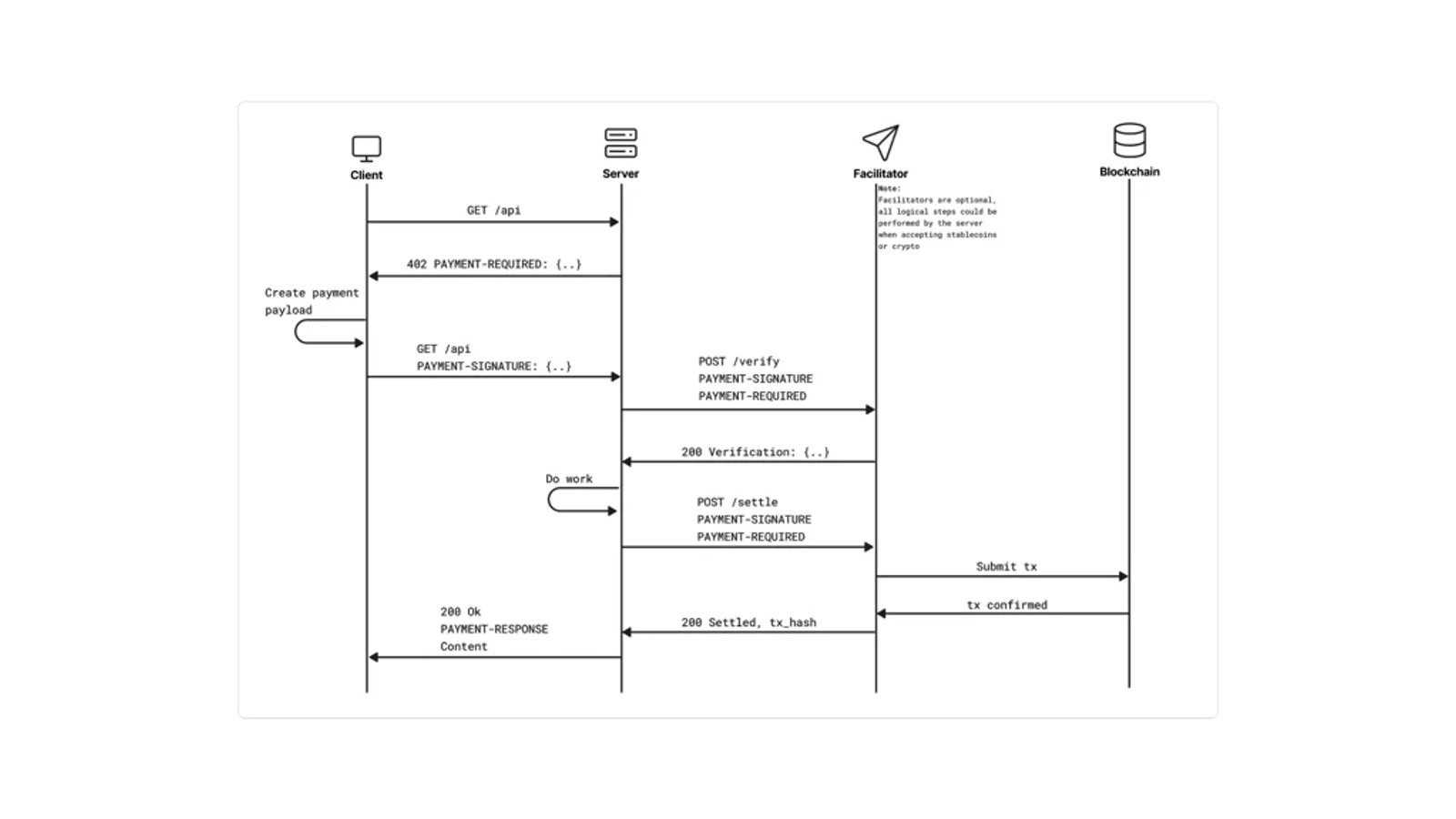
Cloudflare's announcement says customers can place prices on pages, datasets, APIs and Model Context Protocol tools. When a request reaches the edge, the gateway can return a 402 response containing the amount, asset and destination address. The client pays, retries with proof and receives the resource after verification.
A paywall becomes an infrastructure rule
That moves pricing and access control away from custom application code. A publisher still decides what to sell, but Cloudflare can perform the repetitive verification and enforcement close to the user. The company describes settlement as sub-second; real experience will also depend on the supported chain, wallet and client implementation.
One paid request
- A client asks for a protected resource
The request can come from a person, application or software agent.
- The edge returns payment terms
The 402 response identifies price, asset and receiving address.
- The client retries with proof
The gateway verifies payment before allowing delivery.
What Cloudflare handles, and what publishers retain
| Layer | Gateway can handle | Publisher still owns |
|---|---|---|
| Access | Price instruction and payment verification | Which resources are paid and who may buy |
| Settlement | Stablecoin payment path | Accounting, tax treatment and treasury policy |
| Customer experience | Protocol response | Discovery, refunds, support and wallet guidance |
| Content | Delivery enforcement | Rights, quality, updates and product value |
The case for selling access one request at a time
Subscriptions work when a reader expects recurring value from one brand. Per-request settlement is aimed at a different market: occasional human buyers, applications and autonomous agents that want one specific resource. That could make narrow datasets, research archives and specialized APIs easier to sell across borders.
The launch does not prove that those buyers exist at scale. Publishers need evidence that conversion exceeds the friction of acquiring and controlling a wallet. Enterprise users will also require budgets, allowlists, audit trails and spending limits before software agents can buy unattended.
The unanswered commercial layer
Demand
A technically cheap transaction has no value unless the resource is distinctive enough to buy.
Control
Agent wallets need limits, revocation and records that finance teams can reconcile.
After-sales
Protocol settlement does not by itself solve refunds, disputes, taxes or failed delivery.
- Client or agentrequests a resource
- Cloudflare edgeprices and verifies
- Stablecoin walletsubmits payment proof
- Publisher originserves the resource
Client or agent → Cloudflare edge · HTTP request
Cloudflare edge → Client or agent · 402 price instruction
Client or agent → Stablecoin wallet · authorizes stablecoin payment
Client or agent → Cloudflare edge · retries with payment proof
Cloudflare edge → Publisher origin · permits resource delivery
Method: A simplified request path based on Cloudflare's published product description; settlement providers and wallet implementations may vary.
Risks to the thesis
- Which chains, stablecoins and wallet clients become broadly supported.
- Early publisher pricing and conversion data rather than transaction-speed demonstrations.
- Controls for agent budgets, refunds, receipts and enterprise accounting.