
The quarter the AI buildout stopped paying for itself — and the power grid named its price
Between 22 and 30 July 2026 the companies carrying the AI buildout reported record revenues and, in the same documents, surrendered any claim to be funding it themselves: Alphabet raised $49.6 billion of equity and $20.3 billion of notes in a single quarter, Meta's free cash flow narrowed to $784 million, Amazon's trailing free cash flow swung to a $7.6 billion outflow, and Oracle closed its fiscal year $23.7 billion cash-negative against a $638 billion backlog. The constraint on the AI race has moved from chips to balance sheets and transmission lines — and the largest US power market has now failed twice running to buy enough firm capacity at any price.
Reporting sourcesAlphabet — Q2 2026 results, SEC Form 8-K Exhibit 99.1, 22 July 2026: revenues $119.8 billion (+24%); Google Cloud $24.8 billion (+82%); operating income $40.8 billion, margin 34%; other income net gain $98.0 billion, primarily unrealized equity gains; June 2026 equity and mandatory convertible preferred issuance for net proceeds of $49.6 billion to fund general corporate purposes including AI-infrastructure capex; Q2 senior unsecured notes for net proceeds of $20.3 billion; at-the-market program up to $40.0 billion, unsold as of 30 JuneAlphabet — Q2 2026 earnings call, investor relations: full-year 2026 capital-expenditure guidance raised to $195–205 billion from $180–190 billion, citing accelerated capacity deliveryMeta — Q2 2026 results, investor relations, 29 July 2026: revenue $60.80 billion (+28%); costs and expenses $42.03 billion (+55%, including $2.40 billion legal charges and $1.18 billion severance); operating margin 31% vs 43%; capex including finance-lease principal $31.08 billion; operating cash flow $31.86 billion; free cash flow $784 million; full-year 2026 capex outlook narrowed to $130–145 billion; long-term debt $83.66 billionMicrosoft — FY2026 Q4 results, investor relations, 29 July 2026: quarterly revenue $90.0 billion (+18%); Azure and other cloud services +43% in the quarter; Azure surpassed $100 billion for the fiscal year; commercial remaining performance obligation +84% to $678 billion; fiscal-year revenue $331.8 billionAmazon — Q2 2026 results, SEC Form 8-K Exhibit 99.1, 30 July 2026: net sales $200.6 billion (+20%); AWS +37% to $42.2 billion, fastest in 18 quarters, $169 billion annualized; operating income $27.5 billion; net income $62.6 billion including $53.4 billion of non-operating pre-tax income primarily from Anthropic; trailing-twelve-month operating cash flow $161.4 billion (+33%); trailing free cash flow an outflow of $7.6 billion on a $66.1 billion year-over-year increase in property and equipment purchases that primarily reflects AI investment, vs an inflow of $18.2 billion a year earlierOracle — Q4 and FY2026 results, investor relations, 10 June 2026: remaining performance obligations $638 billion (+363% YoY, +$85 billion sequentially); $75 billion of large AI contracts prepaid or customer-supplied in hardware; FY2026 operating cash flow a record $32.0 billion; FY2026 free cash flow negative $23.7 billion; Q4 cloud infrastructure revenue +93%US Department of Energy — release on the 2024 Report on U.S. Data Center Energy Use (Lawrence Berkeley National Laboratory): data centers consumed 58 TWh in 2014 and 176 TWh, or 4.4% of US electricity, in 2023; projected 325–580 TWh, or 6.7–12%, by 2028EIA — Short-Term Energy Outlook, August 2026 release, electricity section: US generation rising to meet data-center demand; solar +21%, hydropower +9%, wind +6% in 1H26; the Texas governor's 3 August pause on new data-center development cut the 2027 Texas load-growth forecast to 6% from 14%Lawrence Berkeley National Laboratory — Queued Up: 2026 Edition (data through end-2025, CC BY 4.0): about 8,200 active projects, 1,312 GW of generation and 749 GW of storage (~2,060 GW total, −10% YoY); active natural-gas capacity +86% to 253 GW; median request-to-operation time over 5 years for projects built in 2025; 13% of 2000–2020 requested capacity reached operationBank for International Settlements — BIS Bulletin No 120: AI investment a substantial share of economic growth; financing shifting from operating cash flow to debt with private credit playing a rapidly increasing role; stability risks moderate but sustainability hinges on earnings expectations, with equity prices far ahead of debt-market pricingQuinn Emanuel Urquhart & Sullivan — client alert, Financing the AI Infrastructure Boom: four-company 2025 capex of $381 billion and a ~$700 billion 2026 forecast on cited press records; AI revenues ~$60 billion vs ~$400 billion capex in 2025; new 2025 borrowing at least $200 billion; ~$1.5 trillion external financing needed by 2028 on one estimate; McKinsey's $5.2 trillion decade cost; over $120 billion moved off balance sheet in under two years; Meta's ~$30 billion Hyperion SPV; Google's $3.2 billion Fluidstack–TeraWulf backstop; CoreWeave's $7.5 billion GPU-collateralized facility; Oracle total debt above $130 billion with $248 billion in new lease commitments and negative credit watch at S&P and Moody's; the January 2026 open letter of four US senatorsS&P Global Ratings — Oracle 'BBB' affirmed, outlook negative, 24 September 2025, on an expected widening free-operating-cash-flow deficitElectric Power Supply Association — summary of the PJM 2027/2028 Base Residual Auction: clearing at the FERC-approved cap of $333.44/MW-day, 134,479 MW securedAvalon Energy — note on the PJM 2028/2029 Base Residual Auction, July 2026: clearing at the $325/MW-day cap; simulated uncapped RTO-wide price of $554.72/MW-day
Eight days in July settled what the artificial-intelligence buildout had become. Between Alphabet's results on 22 July and Amazon's on 30 July, the four companies carrying most of the western world's compute construction reported their quarter ended 30 June: net income of $112.1 billion at Alphabet, $15.8 billion at Meta, $35.8 billion at Microsoft and $62.6 billion at Amazon. Read as a set, the documents surrendered any remaining claim that the buildout funds itself. Alphabet, which earned $40.8 billion of operating income in three months, disclosed that in June it had sold $49.6 billion of its own shares and mandatory convertible preferred stock, and borrowed $20.3 billion more in senior unsecured notes. Meta reported free cash flow of $784 million on $60.8 billion of revenue. Amazon told shareholders its trailing twelve months of free cash flow had swung to an outflow of $7.6 billion. Six weeks earlier, Oracle had closed its fiscal year with record operating cash flow of $32.0 billion, free cash flow of negative $23.7 billion, and a contracted backlog of $638 billion. The AI race is no longer a story about chips. It is a story about who lends, and about whether the grid answers.
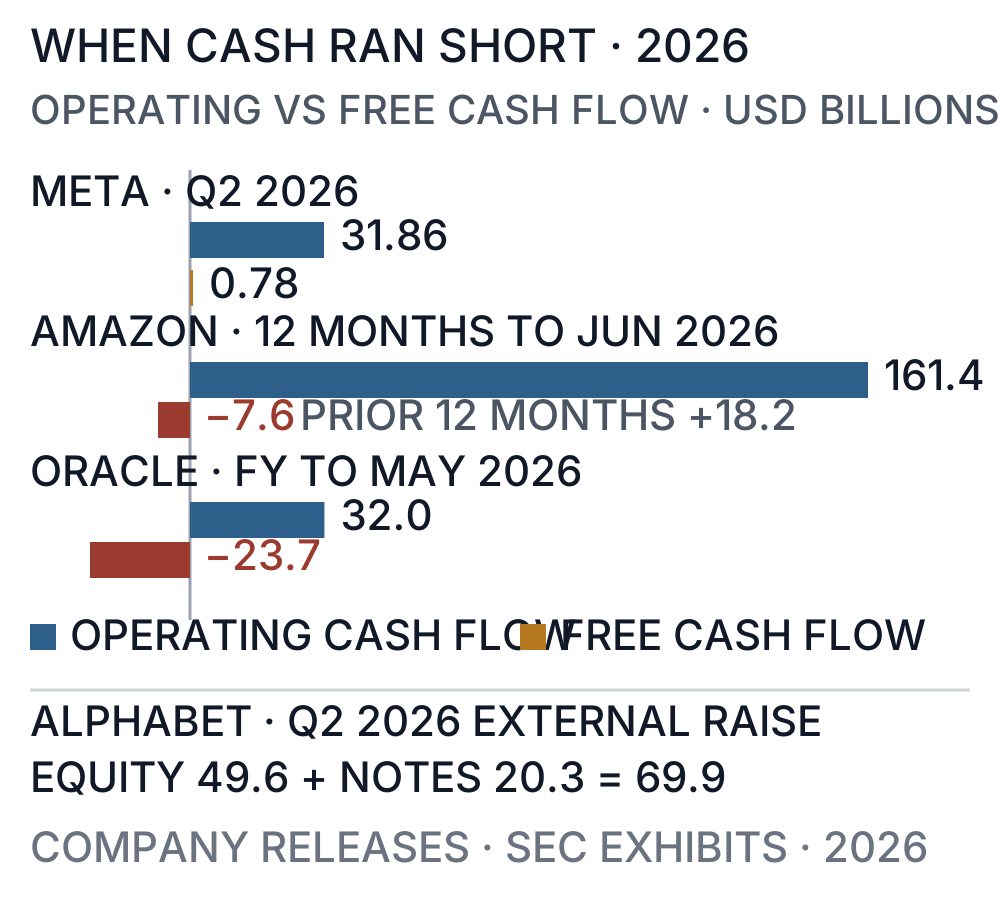
Begin with the strongest balance sheet in the buildout. Alphabet's SEC-filed release records revenue up 24 percent to $119.8 billion, Google Cloud up 82 percent to $24.8 billion, and operating margin expanding two points to 34 percent — a genuinely strong operating quarter. Two other lines in the same filing matter more to this story. The $112.1 billion of net income includes a $98.0 billion net gain in other income, primarily unrealized gains on equity securities: paper marks on private stakes, not cash the business earned. And the cash the buildout requires now comes from outside. The June raise — $49.6 billion of equity and mandatory convertibles, earmarked for general corporate purposes including capital expenditures to scale AI infrastructure and global compute — plus $20.3 billion of senior notes, plus an at-the-market program of up to $40.0 billion standing behind them, unsold as of 30 June, amounts to $69.9 billion of external capital taken in during a single quarter, by arithmetic on the filing's own figures. On the earnings call, management lifted full-year capital-expenditure guidance to $195–205 billion, from the $180–190 billion set in April: the top of the range moved $15 billion in ninety days. The richest operator in the group sold stock into its own record quarter. That is the regime change in one line.
Meta's quarter shows what the buildout does to an income statement even when revenue beats. Revenue rose 28 percent to $60.8 billion; total costs rose 55 percent to $42.0 billion, including $2.4 billion of legal charges and $1.18 billion of severance; operating margin compressed to 31 percent from 43 percent a year earlier. Capital expenditures, including finance-lease principal, were $31.08 billion in the quarter, against $31.86 billion of operating cash flow — free cash flow of $784 million, in a company that earned $15.8 billion for the period on paper. The company narrowed its full-year capital-spending outlook to $130–145 billion, raising the floor from $125 billion. The spending is arriving faster than the revenue it is meant to earn.
Amazon supplied the cleanest statement of the crossover. AWS grew 37 percent, its fastest pace in 18 quarters, to a $169 billion annualized run rate, with the AI and chips businesses each above a $25 billion run rate and growing at triple-digit rates. Operating cash flow over the trailing twelve months rose 33 percent to $161.4 billion. And free cash flow over the same window went to an outflow of $7.6 billion from an inflow of $18.2 billion a year earlier, driven, the release says, by a $66.1 billion year-over-year increase in purchases of property and equipment that primarily reflects investments in artificial intelligence. The largest cash engine in the group is outrunning its own cash. Net income of $62.6 billion includes $53.4 billion of non-operating pre-tax income, primarily the Anthropic stake — the same species of paper gain that flattered Alphabet's bottom line.
Microsoft's disclosure runs through the backlog rather than the financing page. Azure revenue surpassed $100 billion for the fiscal year for the first time, and the Azure and other cloud services line grew 43 percent in the June quarter; commercial remaining performance obligation rose 84 percent to $678 billion; fiscal-year revenue reached $331.8 billion. The release carries no Alphabet-style raise, but a $678 billion contracted obligation is a forward claim on the same construction program, financed on terms the market is now repricing.
Then there is the edge of the stack, where the buildout is explicitly levered. Oracle's June release put remaining performance obligations at $638 billion, up 363 percent on a year earlier and $85 billion in the quarter alone, the company noting that most of the recent increase came from large AI contracts in which the customer prepaid for the GPUs or supplied them outright — customer-funded hardware it puts at $75 billion, which, it says, substantially reduces the capital Oracle must raise. Fiscal-year operating cash flow was a record $32.0 billion; free cash flow was negative $23.7 billion. A client alert from Quinn Emanuel, surveying the financing structures the buildout has spawned, puts Oracle's total debt above $130 billion against $248 billion in new lease commitments, and records that both S&P and Moody's have moved Oracle to negative credit watch; S&P's own action of September 2025 affirmed the BBB rating with a negative outlook, citing an expectation that the free-operating-cash-flow deficit would widen over the following two to three years. A backlog of this size is a promise to build first and collect later, and the market has begun to price the promise rather than the growth.
Around the four balance sheets an entire financing architecture has appeared in under two years, and the Quinn Emanuel alert is the most compact map of it. Capital spending at Alphabet, Amazon, Meta and Microsoft reached $381 billion in 2025, an all-time high, and is forecast above $700 billion this year on the press records the alert cites — against AI revenues it puts at roughly $60 billion for 2025. New borrowing reached at least $200 billion last year, a figure the alert warns understates the total because many deals are private; one estimate it carries sees around $1.5 trillion of external financing needed across the AI ecosystem by 2028; McKinsey's cost of the buildout to the end of the decade stands at $5.2 trillion. More than $120 billion of data-center spending has moved off balance sheets in under two years, through structures the alert itemizes: Meta's roughly $30 billion Hyperion SPV, Google's $3.2 billion backstop of the Fluidstack–TeraWulf transaction, CoreWeave's $7.5 billion GPU-collateralized facility. The collateral behind the newest layer of this lending is the depreciating asset itself.
Washington and Basel have both noticed. In January 2026, four US senators, in an open letter the alert quotes, urged regulators to investigate the sector's reliance on complex and opaque debt markets to borrow staggering sums of cash, warning that an inability to service the debt could cause destabilizing losses for an interconnected set of financial institutions. The Bank for International Settlements, in its Bulletin No 120, makes the same point in central-bank language: AI investment now accounts for a substantial share of economic growth; financing it requires shifting from operating cash flow toward debt, with private credit playing a rapidly increasing role; and while the authors judge the stability risks moderate, the boom's sustainability hinges on AI firms meeting high earnings expectations — with equity prices having run far ahead of debt-market pricing.
The physical half of the constraint is measured with the same precision. The Department of Energy's report on US data-center energy use, produced by Lawrence Berkeley National Laboratory, puts data centers at 58 TWh in 2014, at 176 TWh — 4.4 percent of national electricity — in 2023, and at a projected 325 to 580 TWh, or 6.7 to 12 percent, by 2028. The Energy Information Administration's August Short-Term Energy Outlook records generation rising to meet growing demand from data centers, with solar output up 21 percent and wind up 6 percent in the first half of 2026 — and records, in the same release, that the Texas governor's 3 August pause on new data-center development forced the agency to cut its 2027 Texas load-growth forecast to 6 percent from 14 percent. A state government halting construction to count what is being built is a signal no earnings call can issue.
The price of the constraint prints annually, in the capacity auction of PJM, the largest US power market. The clearing price for the 2024/25 delivery year was $28.92 per megawatt-day. The July auction for 2028/29 cleared at $325 — the cap set under the FERC-accepted price collar, for the third consecutive year — and still procured roughly 6,800 MW less than the grid's reliability requirement; the operator's simulation, reported by the energy advisory Avalon Energy, puts the uncapped clearing price at $554.72. The previous auction, for 2027/28, cleared at its $333.44 cap and secured 134,479 MW, and was the first in the market's history to fall short of the requirement, according to the Electric Power Supply Association's summary of the results and contemporaneous auction records. From $28.92 to a capped $325 is more than an eleven-fold repricing of firm capacity in three years — the grid's own number for what the buildout asks of it.
Behind the auction sits the queue. Berkeley Lab's Queued Up: 2026 Edition, covering interconnection requests through the end of 2025 across operators representing about 98 percent of installed US capacity, counts roughly 8,200 active projects — 1,312 GW of generation and 749 GW of storage, some 2,060 GW in all, even after a 10 percent annual decline. Active natural-gas capacity in the queue rose 86 percent to 253 GW in 2025: the market's first answer to the data-center load is gas. But the median project that reached operation in 2025 spent more than five years from request to connection, and only 13 percent of the capacity requested between 2000 and 2020 had been built by the end of 2025. Capital spending deploys in quarters; the grid answers in half-decades.
Read across markets, the transmission runs four ways. Into technology-equity margins, where Meta's compression from 43 to 31 percent is the printed example and Alphabet's held margin is the externally financed exception. Into power economics, where the capacity line on commercial and industrial bills has climbed about 24 percent in two years — from $98,521 to $122,039 per megawatt-year on the retail advisory Voltus's accounting — whether or not the customer touches AI. Into credit, where a BBB-rated software company carries more than $130 billion of debt against AI backlog and the newest lending is collateralized by the GPUs themselves. And into rates and industrial commodities: the BIS notes the investment wave is now large enough to carry a substantial share of measured growth; S&P Global's January study, Copper in the Age of AI, names the data-center buildout a new structural driver of copper demand; and J.P. Morgan's estimate, carried by the mining trade press, puts data centers near 475,000 tonnes of copper this year.
The strongest reading against all of this deserves full weight. The demand is not hypothetical: in the same quarter, cloud revenue grew 82 percent at Google, 43 percent in Microsoft's Azure line, 37 percent at AWS and 93 percent in Oracle's infrastructure business, and Amazon's AI business alone passes a $25 billion run rate at triple-digit growth. Oracle's $75 billion of customer-funded hardware genuinely lightens the capital it must raise, and a company with $161.4 billion of operating cash flow running a cash deficit is investing, not distressed. The queue shows supply responding — gas up 86 percent in a year — and the Electric Power Supply Association's reading of the capped auctions is that price signals are working and will bring capacity. The BIS authors judge financial-stability risks moderate. If the June-quarter cash deficits prove to be the trough rather than the new run rate, the leverage reading of this quarter dies quietly, and should.
The records that settle the argument are already scheduled. The September-quarter filings will show whether free cash flow recovers at the current guidance, or whether the raised ranges — $195–205 billion at Alphabet, $130–145 billion at Meta — hold while the deficits widen. The 2029/30 PJM auction, run under the collar FERC extended in April, will show whether a reliability shortfall that has now printed twice in a row attracts supply or becomes the system's steady state. Oracle's backlog converts to recognized revenue on a schedule the credit market can check quarter by quarter — and a BBB balance sheet leaves little room for that schedule to slip. Whether the senators' January letter hardens into a formal inquiry into at least $200 billion a year of new borrowing is the one test on the list with no printed date. The buildout's promise was restated this quarter in a new unit — not tokens or parameters, but borrowed dollars and megawatt-days. What changed in July is that both now carry a price, and neither price is set by the companies doing the building.