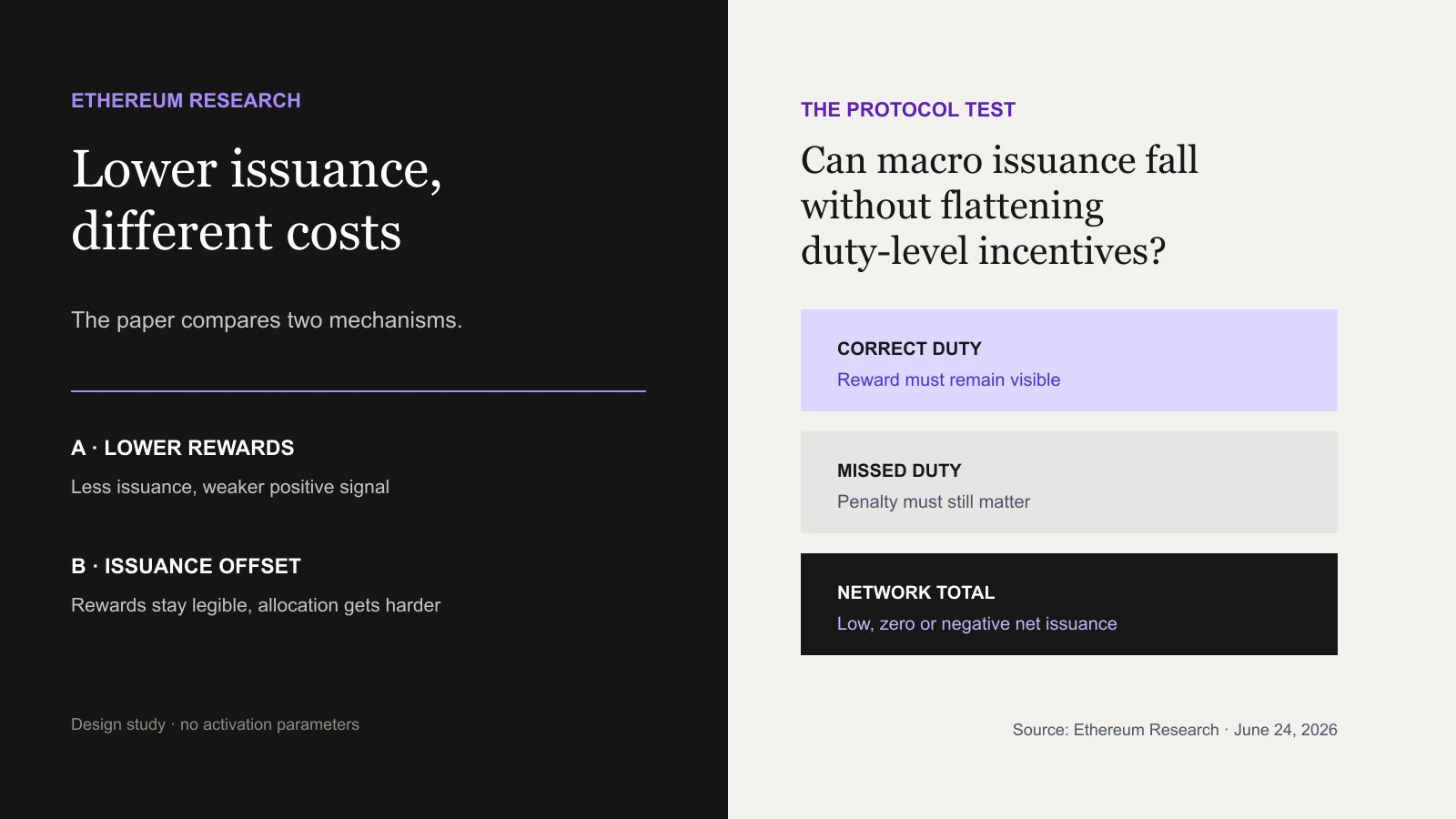
Macro issuance is the total ETH created for staking. Micro incentives are the reward and penalty differences that tell each validator to attest correctly, stay online and support the canonical chain. Simply scaling every reward toward zero lowers issuance, but it also narrows the immediate cost of poor performance.
Two targets inside one issuance debate
The researchers therefore study whether an offset can remove issuance at the aggregate level while leaving duty-level rewards and penalties legible. In principle, the network could retain strong local incentives and still reach low, zero or negative net issuance.
The mechanism trade-off
| Question | Lower rewards + higher penalties | Issuance offset |
|---|---|---|
| Correct duty | Receives less | Reward can remain unchanged before offset |
| Missed duty | Pays a larger relative cost | Existing penalty plus share of offset |
| Aggregate issuance | Falls as reward scale falls | Falls by the chosen offset |
| Main concern | Micro reward signal weakens | Offset allocation may be unfair or destabilizing |
A uniform charge produces uneven consequences
One simple design subtracts the same offset from each validator. The paper shows that this can push a solo validator into negative issuance during an otherwise ordinary epoch, even when the network as a whole remains healthy. A per-duty offset changes that distribution, but adds design complexity.
The relevant unit is not only the average validator. Pools, solo operators and validators with different effectiveness can experience the same aggregate target in different ways. A proposal that looks neutral at network scale can still change who is able to operate profitably.
Failure conditions matter more than the steady-state chart
Penalty design becomes especially important when the chain fails to finalize or when a minority is discouraged from participating. The paper considers how offset and penalty choices interact with minority discouragement attacks. An issuance mechanism that behaves cleanly in ordinary epochs can create undesirable pressure in stressed ones.
That is why the work should be read as a map of design properties. It narrows the questions a future proposal must answer, but does not provide a production parameter set or evidence that Ethereum governance has chosen one path.
Scope of the research claims
- Studied
- Issuance offsets, reduced rewards and increased penalties under low, zero and negative issuance.
- Not specified
- A final reward curve, activation block or adopted protocol upgrade.
- Core test
- Lower macro issuance without erasing the duty-level incentives that secure consensus.
| Reduce rewards and raise penalties | Keep rewards and apply an issuance offset | |
|---|---|---|
| Successful duty | Smaller reward | Reward remains visible; offset reduces net issuance |
| Missed duty | Larger relative penalty | Penalty remains visible; offset can deepen net loss |
| Macro issuance | Lower | Lower, potentially zero or negative |
| Design risk | Weakens positive micro-incentives | Uniform offsets can overburden small or ordinary validators |
Method: Qualitative comparison of the mechanisms studied in the Ethereum Research paper; it is not a final protocol proposal.
Risks to the thesis
- A concrete Ethereum Improvement Proposal with specified parameters and simulations.
- Distributional analysis for solo validators, pools and validators with lower effectiveness.
- Stress tests covering non-finality and minority discouragement scenarios.